Baseball Swing Metrics, Simplified
You just finished a round of tee work. Your bat speed number looks good. Your attack angle is up. But last weekend, you went 1-for-4 with three weak grounders. What gives?
Baseball swing metrics only help when you understand what each number actually measures and how they connect to each other. This guide covers every core Blast Baseball metric in plain English: what it means, what a good number looks like, and how players, parents, and coaches at every level should use the data to build better swings, not just better scores.
The Short Answer: Baseball swing metrics measure the mechanics of your swing before, during, and at contact. Blast Baseball tracks core pre-impact metrics including bat speed, attack angle, and on-plane efficiency, giving you a precise feedback system to identify exactly what to fix and build a more consistent, powerful swing.
1. What Baseball Swing Metrics Actually Measure
Here is the most important thing most swing-data content gets wrong: not all metrics measure the same thing.
Blast metrics fall into three distinct categories. Confuse them and you will chase the wrong numbers.
A. Pre-Impact Swing Mechanics
These are process metrics that describe how the bat moves before it reaches the hitting zone. They are fully in your control on every rep:
– Bat Speed
– Hand Speed
– Rotational Acceleration
– Early Connection
– Connection at Impact
– On-Plane Efficiency
– Attack Angle
– Time to Contact
B. Contact Quality Indicators
These describe what happens when bat meets ball. Exit velocity and launch angle live here. They are influenced by swing mechanics but also by pitch type, location, and timing.
C. Game and Statcast Outcomes
Strikeout rate, barrel rate, and expected stats are downstream results. They reflect weeks or months of swings, not individual mechanics.
Blast measures Category A. That is the category you can actually change in practice. Separating these three layers stops you from panicking over a low exit velocity on one tee session or overcrediting a high bat speed reading when your contact rate is declining.
2. The Core Blast Baseball Swing Metrics
What metrics does Blast Baseball measure?
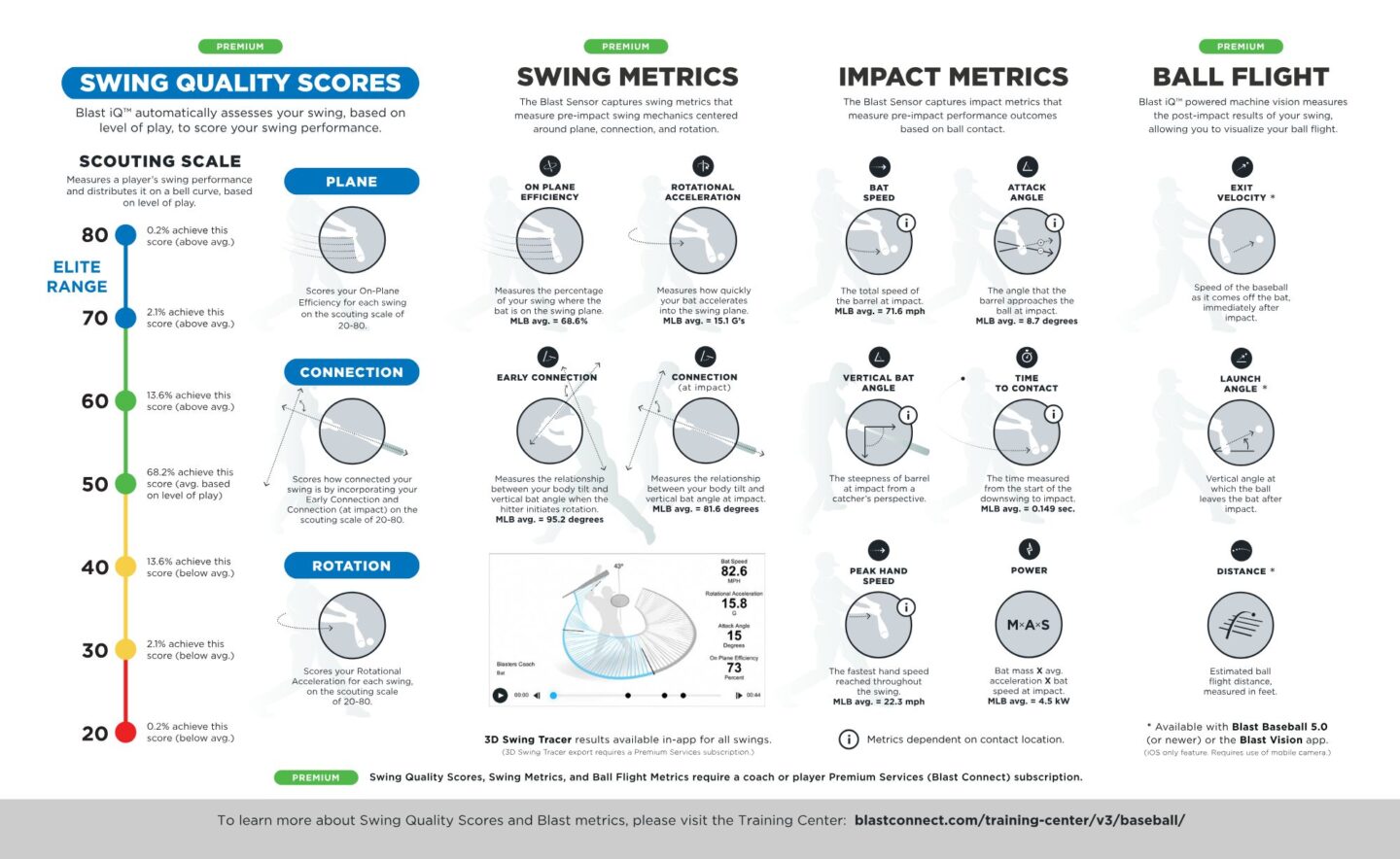
Blast Baseball tracks ten core metrics from its Gen 3 bat-mounted sensor. Here is what each one means:
Bat Speed: The speed of the barrel at the moment of impact, measured in mph. This is your raw power ceiling. Benchmarks: Pro 66-78 mph, High School Varsity 60-70 mph, Middle School 46-62 mph.
Hand Speed: The speed of the hands (measured at the knob) during the swing. A high bat speed relative to hand speed signals efficient barrel whip. A low bat speed relative to hand speed signals that your barrel is dragging or your wrists are breaking down early.
Time to Contact: How long the swing takes from trigger to contact, measured in seconds. Shorter time to contact means more pitch recognition time and better pitch coverage. Elite hitters keep this number tight without sacrificing bat speed.
Attack Angle: The vertical angle of the bat path at contact, measured in degrees. A positive attack angle (5-20°) puts the barrel on plane with the typical downward trajectory of an incoming pitch, maximizing the contact window. A steep negative attack angle produces topspin grounders.
On-Plane Efficiency (OPE): The percentage of the swing that the barrel spends on the hitting plane. 70%+ is optimal; MLB average sits at 68.6%. Higher OPE means a longer contact window and more room for error against off-speed and breaking pitches.
Early Connection: The angle between the lead arm and torso at the start of rotation. Target: 90°, with an optimal range of 80-105°. Losing connection early forces the barrel away from your body and kills OPE.
Connection at Impact: Similar to Early Connection but measured at the moment of contact. It reflects how well your body and barrel stayed linked through the entire swing.
Rotational Acceleration (RA): Think of RA as the “0-60 time” of your swing. It measures how fast you generate bat speed from the start of rotation to peak speed. High RA means explosive hip-to-hands transfer, the kind of power that shows up in games.
Vertical Bat Angle (VBA): The tilt of the bat at contact relative to horizontal. VBA works alongside attack angle to describe your swing plane geometry.
Power: Blast’s composite score combining bat speed and rotational acceleration into a single power-potential output.
Blast iQ™ scores each swing and surfaces color-coded focus areas (green/yellow/red) so you know exactly where to direct your next rep.
3. How the Metrics Work Together
Which baseball swing metrics are most connected?
No Blast metric tells the whole story alone. The most useful diagnostic insight comes from reading pairs and groups.
Bat speed vs. time to contact. A fast swing that starts too early is just a wasted fast swing. Your bat speed number only has value when your time to contact is also efficient. If you are generating 70 mph bat speed but committing 0.20+ seconds before contact, pitchers will beat you with off-speed every time.
Attack angle vs. on-plane efficiency. A good attack angle (10-15°) paired with poor OPE (below 65%) means your path enters the zone at the right angle but exits it too quickly. The fix is usually Early Connection straying outside that 80-105° range.
Connection vs. adjustability. Tight connection (inside the 80-105° window) keeps the barrel close to the body longer, which buys reaction time against breaking balls. Connection that is too tight limits extension and reduces bat speed to the pull side. Your swing decisions at the plate determine which end of the range serves you better.
Rotational acceleration vs. barrel consistency. High RA with inconsistent barrels almost always points to timing, not mechanics. The power is there, but if your commit point is moving pitch to pitch, that explosion will rarely sync with the ball.
4. Which Metrics Matter Most by Player Type
What swing metrics should I focus on based on my role?
Not every metric deserves equal attention at every level or in every role. Here is the priority breakdown:
Players (Youth, 8-12): Focus on bat speed and attack angle only. The goal is swing freedom, not score anxiety. Green on those two metrics is a great session.
Parents: Watch bat speed trends over time and whether your athlete’s On-Plane Efficiency is moving up. These two together tell you whether the swing is developing in the right direction across a season.
Youth Coaches (8-14): Prioritize Early Connection, attack angle, and time to contact. These three mechanics-based metrics tell you what to fix in practice without overloading young hitters with data.
High School Coaches: Add Rotational Acceleration and OPE. Body-driven power and contact window consistency separate varsity starters from bench bats at this level.
College and Pro Coaches: Use the full metric set plus Blast Connect or team dashboards to track individual trends, compare in-game vs. practice data, and build individualized development plans across a full roster.
Scouts: Bat speed and RA are the ceiling indicators. OPE and Connection at Impact tell you whether that ceiling is accessible under game pressure.
Click here to shop Blast Motion and see your swing metrics in real time.
5. Common Swing Metric Diagnoses
What does it mean when one metric is good but another is bad?
High bat speed + poor contact rate: Check OPE first (target 70%+). If OPE is low, look at Early Connection. If connection is outside 80-105°, the barrel is leaving the zone too fast. Cue: “Short to it, long through it” to extend barrel time through the zone.
Good attack angle + low on-plane efficiency: Your bat is entering the zone at the right angle but leaving it too quickly. This is almost always a Connection problem. Run the Stop at Contact Drill to ingrain where the barrel needs to be at impact.
Fast swing + weak exit velocity (with ball flight data): This is a squaring-up problem, not a power problem. Tighten your VBA and use the Shoulder Slot Drill to fix barrel path geometry. Validate with ball flight, not just sensor data.
High rotational acceleration + inconsistent barrels: The explosion is there. The timing is not. Work front toss with variable speeds and track whether your time to contact stabilizes. If your RA stays high and your OPE also improves, you are on the right track.
6. Tools and Methods
What are the best methods for using Blast Baseball data in training?
Three training methods will give you the most reliable metric data and the clearest path to improvement.
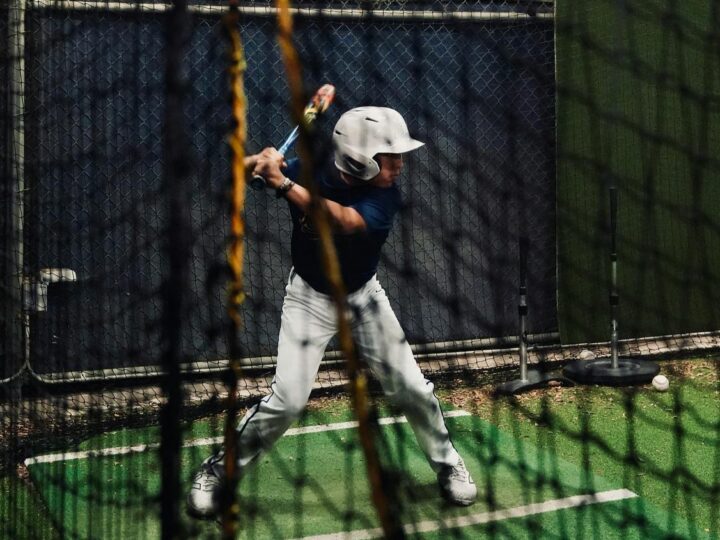
Tee Work: Your baseline environment. Bat speed will be highest here. Use tee sessions to establish benchmarks and isolate mechanics before adding movement. Take your first 10-15 swings before fatigue sets in for the cleanest data.
Front Toss: The bridge between mechanics and timing. Expect bat speed to drop slightly compared to tee work. Track whether OPE and attack angle hold up when you introduce a moving ball. Improvement in these metrics during front toss confirms that mechanical gains are real.
Live At-Bats: The proving ground. Metric variability here is normal. Use Air Swings between live pitches to reinforce mechanics in the moment. If your time to contact stabilizes across a live session, your timing is catching up to your mechanics.
7. How Blast Motion Helps
Blast Baseball pairs the Gen 3 bat sensor with the Blast iQ™ app, built specifically for baseball players at every level. The sensor mounts to the knob of the bat and captures all ten core swing metrics in real time. Blast iQ™ scores each swing with color-coded feedback so you know exactly where to focus your next rep. Coaches can use Blast Connect to track full rosters, compare in-game and practice data, and build individualized development plans, making it one of the most complete swing analysis systems available for baseball.
8. How to Trust and Use Your Swing Data
How do I know if my Blast Baseball readings are accurate?
Blast Baseball has captured 400M+ swings. That data set is the foundation for every benchmark in the app. But individual readings still require context to be useful.
Sample size matters. A meaningful baseline requires at least 10-15 swings per session in consistent conditions. Use session averages and weekly trends, not single-swing peaks.
Bat weight and length affect readings. A drop-3 and a drop-8 will produce different bat speed numbers from the same swing. If your bat weight changes, re-establish your baseline before drawing conclusions.
Fatigue is real. Bat speed drops 2-5 mph in long sessions. Take your first 5-10 swings as your cleanest data, not your last.
Use Blast iQ™ color codes as directional signals, not pass/fail grades. Yellow does not mean broken. It means that is the highest-leverage area to work on next.
9. Turning Numbers Into Better Swings
How do I turn Blast swing data into actual improvement?
Data without action is just a scoreboard. Use this four-step workflow to close the loop between your numbers and your results.
- Identify the metric. Open Blast iQ™ and find your lowest green metric or your first yellow/red flag. Work on one metric per training block, not all of them.
- Translate it to a visual cue. Connect the number to a feel. Low Early Connection? Cue: “Back pocket down the line” to keep the pelvis loaded and the lead arm connected. Low OPE? Cue: “Short to it, long through it.”
- Validate through a drill. Run a purpose drill tied to that cue, such as the Torque Drill for connection issues or the Dead Legs Drill for over-reliance on the lower half at the expense of barrel path. Take 10-15 swings and check whether the target metric moves.
- Check it in game conditions. Once the metric improves in practice, introduce front toss and live pitching with Air Swings in between for reinforcement. If the improvement holds under pitch variability, it is real. If the metric regresses under live velocity, the timing component needs more work.
Metrics improve in practice first. Game performance catches up when the mechanics are automatic, not when you are thinking about them at the plate.
Supporting Resources
- Blast Baseball sensor and app: full product details and purchasing
- Blast Baseball features: Blast iQ™, Air Swings, Coach Mode, video overlays, and team tools
- Blast Connect coaching dashboard: player reports, remote coaching, and team metric tracking
Smarter Swing Improvement
Baseball swing metrics are not grades. They are a feedback system. The players and coaches who improve fastest are the ones who treat each number as a question, not an answer. Read the metrics together, work on one thing at a time, and let game performance be the final confirmation that the work is showing up where it counts.
Click here to shop Blast Motion and start measuring the swing metrics that matter.