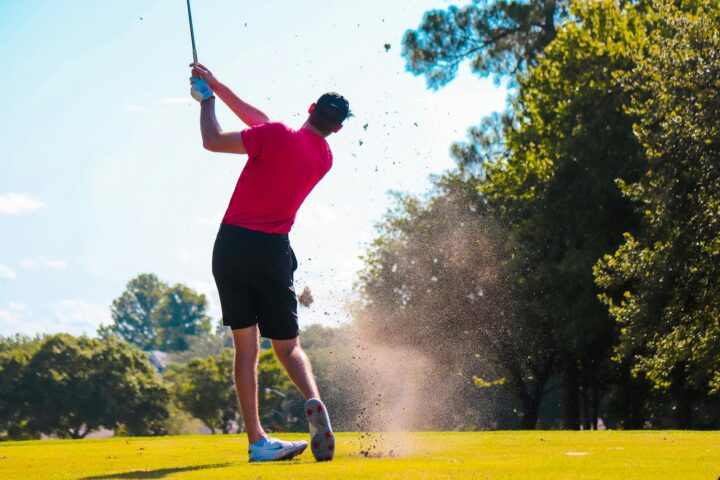
You aim down the middle. The ball starts right of your target, then peels further right and finishes in the trees. Same slice, every hole. Here’s the direct answer: your golf face rotation swing pattern is off. Face rotation is how the clubface opens and closes through your swing, and it’s the single biggest factor in where the ball starts and how it curves. Feel won’t fix it, because feel can’t see it. A grip-mounted sensor can. That’s where Blast Golf changes the conversation.
What Golf Face Rotation Actually Is
You’ve been told to “square the face.” But square when? At address, the face points at the target. During the swing, it doesn’t sit still. It turns.
Face rotation is that turning motion: the clubface moving from open to square to closed as it travels through the backswing, downswing, and impact. It’s measured in degrees by the grip-mounted Blast Golf sensor, which reads the club itself rather than guessing from ball data.
Here’s the distinction that matters. A launch monitor gives you one snapshot: face angle at impact, a single number at one instant. Useful, but incomplete. Blast Golf captures the rotation through the whole swing, so you see how the face gets to impact, not just where it lands.
That difference is everything. Two golfers can arrive at the same impact face angle by completely different routes. One rotates smoothly. The other flips and saves it late. Same snapshot, very different consistency. Measure the motion, not just the moment.
Why Face Rotation Decides Your Ball Flight
You blame your grip. You blame your stance. But the face is what talks to the ball.
Modern ball-flight physics is clear: the face angle at impact controls most of your start direction, and the face-to-path relationship controls the curve. Leave the face open to your path and you get a push or a slice. Shut it closed and you get a pull or a hook.
So chasing a better swing plane while ignoring the face is backwards. The plane influences the path. The face still decides where the ball launches.
This is why face rotation deserves its own metric. If your face is arriving open every time, no amount of grip tinkering sticks until you can see the rotation change and confirm it. Fix the face first, then the ball flight follows.
Square Isn’t Frozen: The Rotation Myth
You hear it on every range: “hold the face square through impact.” So you tighten your hands, brace the wrists, and try to freeze the clubface. The ball still leaks right. Now you’re confused and tense.
Here’s the truth. The face is always rotating. A held, frozen face is a myth and a trap. Trying to stop rotation usually leaves the face open at impact, which is exactly the slice you were trying to kill.
The real goal isn’t a frozen face. It’s controlled, repeatable rotation: the same amount of turn, at the same time, swing after swing. Because Blast Golf reads that turn in degrees, “the same amount” stops being a feel and becomes a number you can repeat. Square isn’t a position you hold. It’s a moment you pass through on the way from open to closed.
That reframe takes pressure off. You’re not fighting the club. You’re timing a rotation you can measure and repeat. Stop holding. Start owning the turn.
How to Measure Face Rotation with Blast Golf
You can feel a swing change and still have no idea whether it worked. Feel lies. Data doesn’t.
The Blast Golf sensor mounts on the grip end of your club and reads your motion directly. It tracks club speed, tempo, face rotation, attack angle, hand speed, and detailed putting metrics for both speed and direction control. For face rotation specifically, here’s how you actually use it:
- Blast iQ traffic-light goal ranges. Green, yellow, red indicators show whether your rotation sits in a healthy range. Goals are benchmarked by your handicap and club type, so a driver target differs from a wedge target. No guessing at a “correct” number.
- Session trends. Watch your rotation consistency move over a session and across weeks. Trends beat single swings.
- Auto-edited video with overlays. Your swing data appears on the video, so you can see the rotation, not just read it.
- Air Swings. Log no-ball reps anywhere, so you can groove controlled rotation in the living room or on the range.
Because there’s no magic universal “degrees” number that fits every golfer, you don’t chase one. You chase green on your own Blast iQ range and a trend line that’s tightening. LIVE swing data. Real feedback. That’s how you turn a vague feel into a repeatable move.
Drills to Control Your Face Rotation
You’ve made a good pass, but you can’t repeat it. The change won’t stick because you’re grading it by feel. Tie your face rotation work to your tempo, then let Blast confirm it.
- Tempo gate. Groove a full-swing tempo ratio between 2.8:1 and 3.2:1, the tour range. Rushed transitions throw off face timing. Steady tempo makes rotation repeatable.
- Slow-to-full ladder. Hit three half-speed swings, then one full swing, watching your Blast iQ light stay green on each. Speed up only when the rotation holds.
- Air Swing reps. Log Air Swings with no ball to feel the release without result anxiety. Check that your rotation trend stays inside range.
- Gate-and-video. Pair a metronome tempo with auto-edited video overlays so you see the face turn match the timing you feel.
- Club-by-club check. Run the same drill with a wedge, a mid-iron, and the driver, because your Blast iQ target shifts by club type.
Want a second angle on the motion in 3D? Sportsbox AI is a complementary video option that pairs well with your Blast data. The rule stays the same across every drill: don’t trust the feel, confirm the change. If the light turns green and the trend tightens, the drill worked.
Turn One Good Swing Into a Repeatable One
One flushed shot proves nothing. Repeatability is the whole game. That’s the gap between a range hero and a scoring golfer.
Use session tracking and trends to prove your rotation is holding across days, not just during one warm bucket. A tightening trend line is real progress you can see. Blast is built on 400M+ captured swings and trusted by 200+ Tour professionals, so your numbers sit in serious context and against a standard that means something.
Then handle the part no sensor touches: your head. Belief and conviction matter as much as mechanics. A golfer thinking about clubface degrees mid-swing breaks down. Do the measuring in practice. On the course, commit and swing. Trust the reps you already banked.
Supporting Resources
- Blast Golf product page
- Blast Golf training videos and coaching resources
- How to Read Blast Motion App Data
You now know what face rotation is, why it decides your ball flight, and how to measure and repeat it. Stop guessing at the face. Measure it, groove it, and take a swing you trust to the first tee.