Saturday cage block. Twelve hitters, two nets, ninety minutes, and a tournament in the morning. You move down the line, watch swing after swing, and trust your eyes to catch what is breaking down. Swing sensors give travel ball coaches a better way to run that block. A knob-mounted sensor turns every rep into objective, measurable data, so you coach all twelve with one standard instead of gut feel. This guide walks through the metrics that matter, running sensors across a full roster, age-appropriate coaching, and turning numbers into drills.
Why Travel Ball Coaches Need Objective Swing Data
You already know your fastest hitter by watching. But watching twelve swings in a row hides the details that decide at-bats. Two hitters can look identical at contact while one barrels the ball and the other rolls over. The eye misses plane and the small speed gaps that separate a single from a fly out.
A swing sensor closes that gap. It measures each swing the same way, every time, so your feedback stays consistent from the first hitter to the last.
Ground your reads in the Three Pillars of Good Hitting: Bat Speed, Bat-to-Ball, and Swing Decisions. Bat Speed sets how hard the ball can leave the bat. Bat-to-Ball shows how repeatably a hitter squares it up. Swing Decisions cover what a hitter chooses to attack. Sensor data gives you an honest number for the first two and a shared vocabulary for all three.
Takeaway: before your next cage block, decide which of the Three Pillars each hitter needs most, then let the sensor confirm it.
The Metrics That Matter for a Travel Roster
Data helps only when a hitter knows which number to chase. These metrics carry the most weight for a travel roster.
- Bat Speed: how fast the barrel moves through the zone, in mph. It sets your power ceiling.
- On-Plane Efficiency: how much of your swing stays on the plane of the pitch. Target 70% or higher. The MLB baseball average sits near 68.6%, so treat that as a baseball-only reference and do not hold softball hitters to it.
- Early Connection: the angle between your torso and the bat at the Transition Event, where the swing begins. Aim for about 90°, inside an 80–105° range.
- Rotational Acceleration: the 0–60 time of the swing, or how quickly the barrel builds speed. High Rotational Acceleration shows up as game power.
- Time to Contact: how quickly the barrel reaches impact once the swing starts. Lower numbers buy time against velocity.
Do not hand a hitter all five. Pick 2 or 3 metrics per athlete so the feedback stays clear. A middle schooler chasing bat speed and on-plane efficiency will improve faster than one drowning in every reading at once.
Takeaway: assign each hitter their two or three numbers this week, and post the target where they can see it.’
Equipping and Managing the Whole Roster
Metrics only help if you can run them across a real roster, not one hitter at a time. This is where a sensor system earns its place at travel practice.
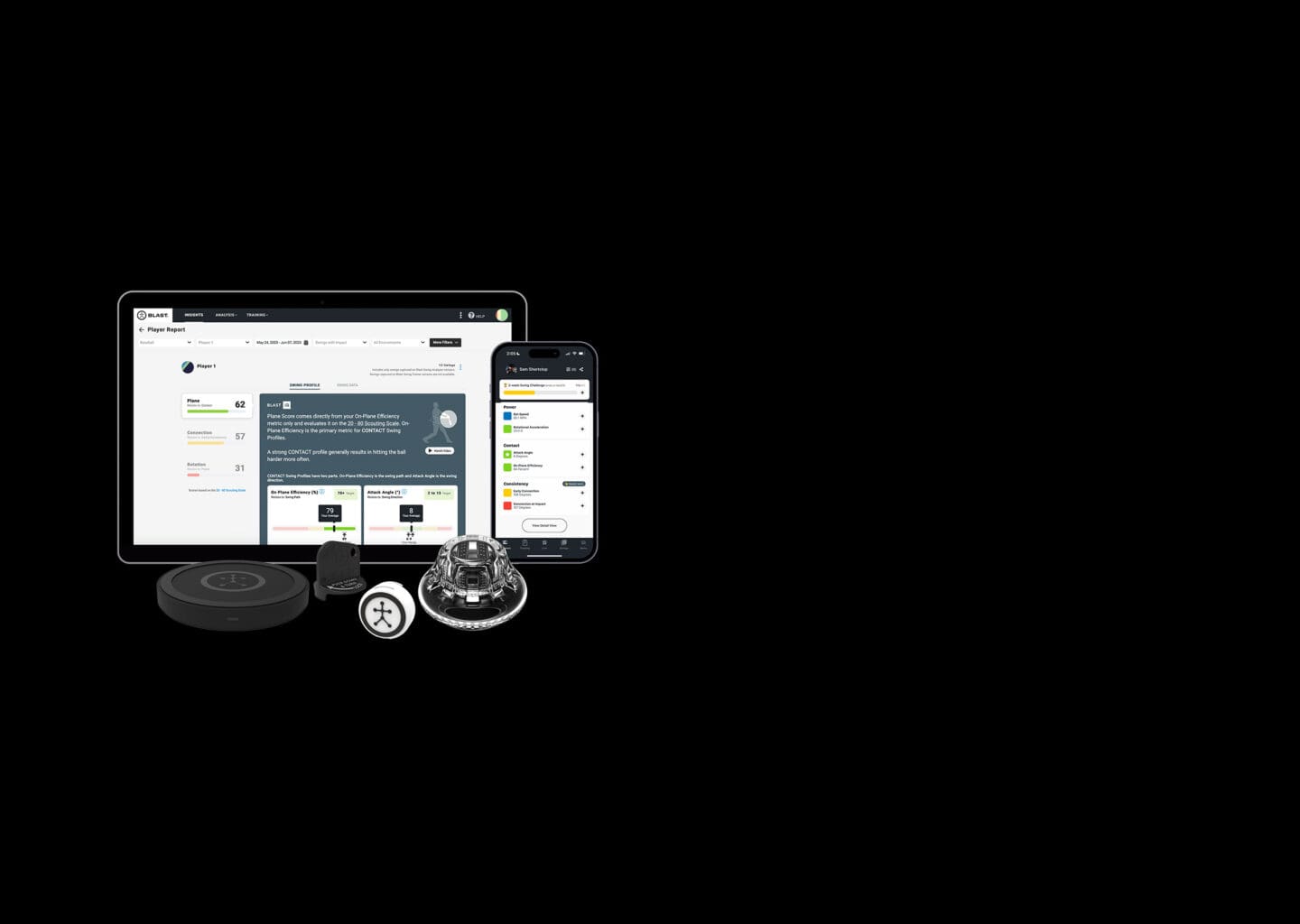
Blast Baseball and Blast Softball both use a bat-mounted Gen 3 sensor paired with the app, and you reassign a single sensor between hitters in seconds. One sensor can move down the line through a group cage block. Coach Mode lets you capture and review swings for the whole group, then push team and player reports after practice. Leaderboards turn bat speed or on-plane efficiency into friendly competition your hitters want to win.
You can bulk upload session data, then send targeted feedback through remote coaching when players train on their own between tournaments. Blast Baseball is trusted by more than 300 college and pro programs and 83% of pro organizations. Blast Softball is the official partner of USA Softball and the USA Softball Women’s National Team.
Takeaway: set up Coach Mode before your next practice, then use one sensor per net and reassign it as hitters rotate.
Age-Appropriate Coaching Across Your Roster
Your 10-year-old and your 17-year-old do not need the same feedback. Match the metric to the stage.
Youth (8–12): Lead with Bat Speed and On-Plane Efficiency. Keep it to movement quality and one speed number they can watch climb. Travel baseball hitters here often sit below the 46–62 mph middle school band, and softball 12U–14U travel hitters land around 38–52 mph.
Middle School (13–14): Add Early Connection so hitters learn to hold their angle into the turn. Baseball bat speed runs 46–62 mph, while softball at this stage tracks the 38–52 mph travel band and climbs toward HS JV at 42–56 mph.
Advanced (15–College): Layer in Rotational Acceleration and Time to Contact. Baseball HS varsity runs 60–70 mph, and softball climbs from 16U–18U travel at 54–66 mph to college at 58–70 mph.
Takeaway: pick the lead metric for each age group tonight, and remember softball and baseball benchmarks are not interchangeable.
Click here to shop Blast Motion
Turn Data Into Drills
A number without a drill is just a scoreboard. When the sensor flags a problem, match it to the exact fix.
- Low bat speed from weak hip-shoulder separation: run the Torque Drill and the Knob to Knee Drill. Cue it with “Back pocket down the line” to load the pelvis.
- Over-rotation, pulling off the ball, or Early Extension: use the Dead Legs Drill to isolate the upper body. Do not use it to build separation.
- Casting, with the barrel leaking away from the body: the Stop at Contact Drill. Cue “Short to it, long through it.”
- Weak or inconsistent forward move, or a Sway: the Walk Through Drill. Cue “Land firm, turn behind your front hip.”
- Poor hip-shoulder separation in general: the Shoulder Slot Drill or the Torque Drill.
For off-season and indoor travel training, use Air Swings so hitters can log measured reps with no ball and no cage.
Mechanics and mental approach work together, and a hitter thinking about mechanics mid-swing usually breaks down. Coach the fix between reps, then let them compete on the next pitch. Cue “Slow and early” when timing is the problem.
Takeaway: pair every flagged metric with its drill this week, then re-measure to confirm the fix held.
Does the Data Actually Hold Up?
Coaches ask a fair question: can you trust the numbers? Mostly, yes, with honest limits. A 2022 study in the journal Sports, by Morishita and Jinji, found bat-mounted sensors valid and reliable for core swing metrics. It also noted lower accuracy on some swing-angle measures. Treat speed and timing as dependable, and read angle metrics as trends rather than exact degrees.
The payoff shows up with two strikes. League average drops to .165 with two strikes in both baseball and softball. If a hitter cuts swing-and-miss with a shorter two-strike approach, that can mean 15 to 20 more hits across a season.
Takeaway: build a two-strike plan around Time to Contact, then use the sensor to prove the shorter swing still plays.
Supporting Resources
- Compare the Blast Baseball sensor and app for your baseball roster.
- Compare the Blast Softball sensor and app for your softball roster.
- See how remote coaching keeps players on track between tournaments and read 5 Ways Baseball Coaches Can Use Tech for more ways to build tech into practice.
Closing
Objective data turns a crowded cage block into roster-wide development. Set each hitter’s metrics, match flaws to drills, and re-measure. Do that all season, and you build a better roster one confirmed swing at a time.