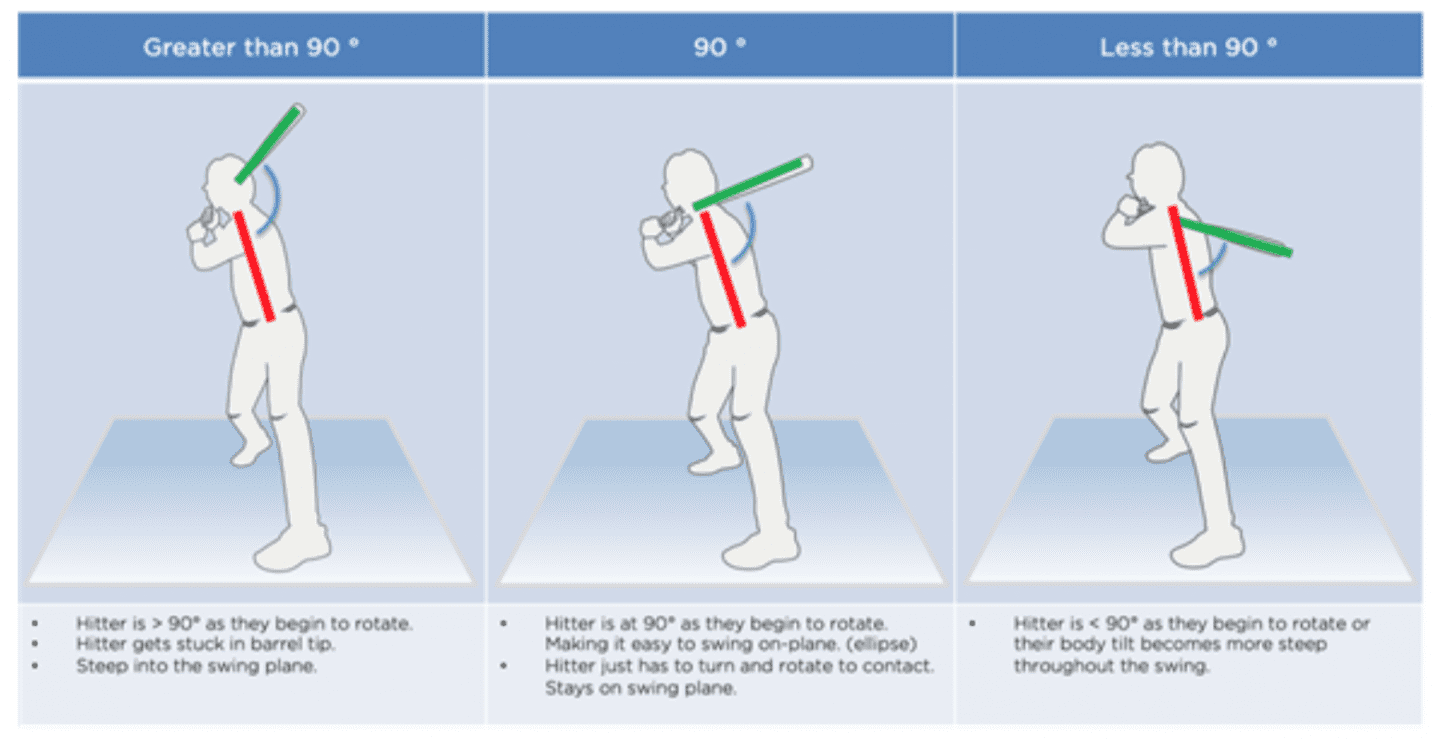
Early connection in baseball is a Blast Motion metric that measures the angle between your body tilt and your vertical bat angle at the start of your downswing. The target is 90 degrees, with an accepted range of 80 to 105 degrees. It tells you whether your barrel and body are working together the moment rotation begins.
Why Early Connection Matters
You load, you fire, and the ball goes dead to the pull side or dies off the end of the bat. The swing felt fine, but something broke down before contact even happened. More often than not, that breakdown starts at the very beginning of the swing, before your hands ever move.
Early connection in baseball hitting is a Blast Motion metric that tells you exactly where your barrel is when your body starts rotating. Get it right, and you are building every swing on the same foundation. Get it wrong, and your bat path, exit velocity, and plate coverage all pay the price. This guide breaks down what the number means, what it feels like, and how to use it.
1. Early Connection in Baseball Hitting: The Definition
A. The Technical Definition
Early Connection measures the relationship between your body tilt and vertical bat angle at the start of the downswing. The ideal score is 90 degrees, which helps you get on plane and increases your ability to adjust to all pitch locations.
B. What It Is Not
Early Connection is not the same as being “early” in timing. A hitter can fire at the perfect moment and still have poor Early Connection if the barrel is in the wrong position relative to the body when rotation begins. Timing is about when you swing. Early Connection is about the structural relationship between your body and bat at that moment.
C. Why the Load Matters
Early Connection is the starting point of the swing, after the load, and shows how consistently the load move puts a hitter into their best hitting position. It captures the angle formed between your torso tilt and your barrel position the moment your body commits to rotate forward.
2. What the Number Tells You
Ninety degrees is the ideal score. The average Early Connection for affiliate professional hitters at Driveline is 90.72 degrees, with a preferred target range of 80 to 100 degrees. Blast Motion’s own target range spans 80 to 105 degrees.
Here is how to read your number:
- 80–105°: You are in range. Your barrel and body are working together at the start of rotation. Focus on maintaining this across all swing environments.
- Below 80°: Your barrel is likely too upright at commitment. The bat is steep, the swing has to recover, and you will struggle to stay on plane.
- Above 105°: Your barrel is already too flat or laid off, which can point to a drag or cast pattern before you enter the hitting zone.
- Inconsistent swing-to-swing: Hitters should strive for a consistent load into their hitting position, which results in consistent Early Connection numbers in your app or on Blast Connect.
As Early Connection moves further from 90 degrees in either direction, a hitter will struggle with consistency, contact quality, and adjustability.
3. What Early Connection Should Feel Like
Most coaching cues go wrong here. Telling a hitter to “stay tight,” “keep the hands in,” or “don’t let the barrel drop” creates stiffness and mechanical swings that fall apart at higher velocities.
What you are actually looking for is a connected launch position, not a locked one. When you finish your load and your front foot lands, your barrel should feel stacked behind your body, not dragging below the zone or floating away from your torso. Your hips initiate the turn, and the barrel rides with your body’s tilt.
Good cues that point to the right feel:
- “Back elbow slots to the back pocket” at the top of your load
- “Land firm, turn behind your front hip”
- “Slow and early into your slot”
When Early Connection is poor, it becomes more difficult to get the barrel on plane with the pitch, forcing the hitter to manipulate the bat with their hands too early rather than using their torso effectively. The goal is a natural, repeatable position, not a locked one.
4. Reading the Metric With Ball Flight
Your Early Connection number does not exist in isolation. Pair it with what the ball is telling you, and the diagnosis becomes fast and clear.
Low Early Connection (below 80°) symptoms:
– Weak opposite-field contact
– High strikeout rate on pitches below the zone
– Short, choppy swing path with little extension
– Low On-Plane Efficiency, below 70%
High Early Connection (above 105°) symptoms:
– Pull-side rollovers and weak ground balls
– Casting, with hands extended before the barrel enters the zone
– Power loss on the outer half
Inconsistent Early Connection swing to swing:
– When a hitter goes out of their target range and shows erratic Early Connection metrics, performance drops, corresponding with lower batting average, slugging, and average exit velocity
– Exit velocity variance increases even when bat speed stays steady
When you see these ball-flight symptoms, check your Early Connection number first. It is one of the fastest indicators of a loading problem that has not yet been identified. From there, use it alongside the metrics that reveal what happens downstream.
5. Tools and Methods: Checking Early Connection in the Cage
You do not need a full analysis session to get useful Early Connection data. Here are three methods to self-check in 20 minutes using your Blast Baseball sensor.
Method A: Tee Baseline
Hit 10 reps off a tee at belt height, middle of the plate. Record your Early Connection for each swing. This is your baseline — no timing pressure, no pitch shape, just mechanics. If your numbers are already outside 80 to 105 degrees here, the issue lives in your load pattern, not your timing.
Method B: Front Toss Comparison
Move to front toss at the same location. Check whether your Early Connection numbers shift. If they jump more than 5 to 8 degrees from your tee baseline, your load is reacting to the ball instead of staying consistent.
Method C: Live BP or Machine Velocity
Add game-speed velocity. If Early Connection drifts high above 105 degrees under pressure, your load is breaking down. If it drops below 80 degrees, you may be getting long and steep trying to catch up. Use Blast’s auto-edited video with metric overlays to watch your load position at your first move, and set your best and worst numbers side by side in the app for a clear visual comparison.
Click here to shop Blast Motion
6. When Not to Chase 90°
Here is a performance-first truth: a 90° Early Connection number does not guarantee a good swing, and a number that sits at 95° or 100° is not automatically a problem.
In-range Early Connection (80 to 105 degrees) combined with in-range Connection at Impact (90 to 95 degrees) equals a low-maintenance swing. The range exists for a reason: body type, posture, pitch location, and individual load pattern all affect where you naturally sit within that window.
Pump the brakes on chasing 90° when:
- Your ball flight is good and your exit velocity is consistent. Do not disrupt a working pattern to hit an arbitrary number.
- Pitch location moves the number. A high fastball and a low outside breaking ball will produce different Early Connection readings because your body tilt changes. Evaluate in context, not in isolation.
- You have a good Early Connection number but disconnect later. A hitter can check in at 88° and then cast through the zone, dropping Connection at Impact well below the 90 to 95 degree range. Early Connection is the start of the story, not the whole thing.
- Your load is creating stiffness. If you are forcing the barrel into a position to hit a target number, you are over-engineering a natural movement. The goal is a repeatable, athletic load, not a manufactured one.
Use Early Connection as a directional signal. Let your exit velocity, on-plane efficiency, and ball flight confirm whether the number is telling the full truth.
How Blast Motion Helps You Improve Early Connection
The Blast Baseball sensor captures your Early Connection on every swing and surfaces it through Blast iQ, color-coded green, yellow, or red, so you can see exactly where your focus areas are without manually tracking each number.
Here is how to pair the metrics for faster improvement:
- Early Connection + Connection at Impact: Connection at Impact measures the relationship between your body tilt and vertical bat angle at the moment of contact, serving as an indicator of dynamic adjustability. If Early Connection is in range but Connection at Impact is not, the barrel is disconnecting mid-swing. Look at your casting pattern and extension.
- Early Connection + On-Plane Efficiency: The target is 70% or higher. Poor Early Connection forces hand manipulations that take the barrel off plane early, driving OPE down. Fix the load, and OPE typically improves without additional work.
- Early Connection + Rotational Acceleration: Rotational Acceleration measures how quickly your bat accelerates into the swing plane and shows whether you are building bat speed through proper sequencing or pulling the bat with your hands. Poor Early Connection often produces low RA because hitters compensate with their hands instead of using rotational power from the torso.
- Early Connection + Bat Speed: If bat speed is dropping and Early Connection is drifting out of range at the same time, restore the load position first, then measure whether bat speed recovers.
Blast Connect gives you trend data, team reports, and remote coaching access so you can track Early Connection across sessions and confirm whether changes in your load are sticking.
Supporting Resources: Related Blast Motion Tools
- Blast Baseball Sensor — tracks all swing metrics including Early Connection, Connection at Impact, Bat Speed, Rotational Acceleration, Attack Angle, and On-Plane Efficiency
- Blast Connect — web platform for tracking trends, team reports, and remote coaching
- Early Connection Metric Overview — Blast’s official metric definition on Blast Connect
- Driveline Baseball: Early Connection Deep Dive — additional biomechanical context on Early Connection scoring
Start with your tee baseline, track it under live conditions, and use these tools to find out exactly where your load is breaking down.
Build a More Connected Swing
Early Connection is a starting point, not a finish line. Use it to confirm your load is repeatable, pair it with the metrics that reveal what happens next, and let your ball flight tell you whether the numbers are translating.