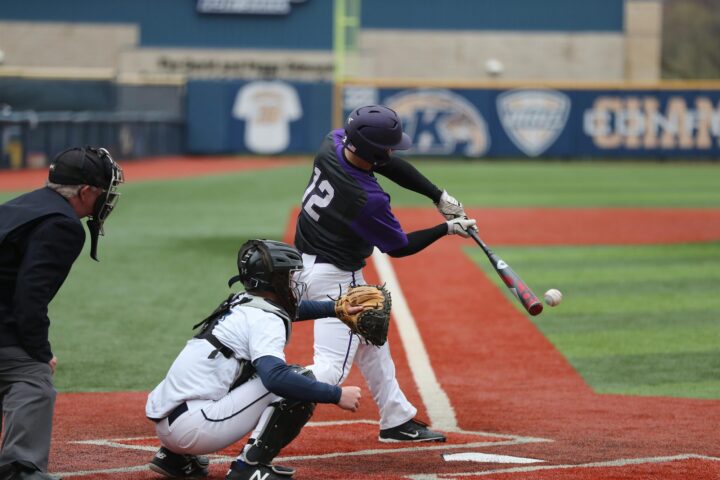
You step into the cage, take 20 swings, and walk away with the same feedback you always get: “Looks good.”
But what’s actually happening at the moment your barrel meets the ball?
Understanding attack angle in baseball is how you answer that question — and most hitters have never seen their real number. This article breaks down the definition, why it drives batted-ball outcomes, how it differs from launch angle, what your number should actually look like, and how to measure it yourself with Blast Motion.
The Short Answer: Attack angle in baseball is the vertical angle of the bat’s path at the moment of contact, measured relative to horizontal. Positive means the barrel is traveling upward; negative means it’s going down. The target range for most hitters is 6–14°, and you can measure it precisely with a Blast Motion bat sensor.
1. Attack Angle Defined
Attack angle is the angle of the bat’s path, at impact, relative to horizontal. A positive value indicates swinging up, and a negative value indicates swinging down, where zero is perfectly level, according to Blast Motion’s metric reference.
A. Positive Attack Angle
Your barrel is traveling upward through contact. The bat path matches the downward plane of the incoming pitch. This is the ideal window for line drives and hard contact.
B. Neutral (Zero) Attack Angle
Your barrel is perfectly level at impact. Sounds clean, but it’s harder to stay on the pitch plane than you’d think, and it leaves very little margin for error against breaking balls.
C. Negative Attack Angle
Your barrel is driving downward at contact. Ground balls and weak contact follow consistently.
As MLB’s Statcast team explains, attack angle tells you what’s happening with the bat at contact and at what vertical angle the bat is moving as it impacts the ball. This is a contact-moment metric, not a full-swing shape metric. It captures one precise instant: the frame your barrel finds the ball. Everything before and after is context.
2. Why Attack Angle Matters
Pitches don’t arrive flat. The average fastball crosses the plate at a 6-degree downward angle, while a breaking ball crosses at a minimum 10-degree downward angle, per Blast Connect’s attack angle resource. That means a perfectly level swing is already working against the pitch plane on most pitches you’ll see.
Attack angle matters for two reasons:
First: contact probability. Matching the bat path to the pitch path increases the likelihood of contact. Because the pitch is thrown from an elevated mound, it arrives on a downward angle, so a positive attack angle provides more opportunity to execute against a variety of pitches that vary in height, speed, and break.
Second: ball flight. A higher attack angle, assuming square contact, is more likely to produce a fly ball. A lower or negative attack angle is more likely to produce a ground ball, as MLB’s Statcast glossary notes.
The sweet spot sits between those two outcomes. A slightly positive attack angle that matches the pitch descent gives you the longest window of barrel-to-ball contact, which means more line drives, more consistent hard contact, and more forgiveness when timing is slightly off. Research shows a bell curve peaking between 5–15 degrees for well-struck balls, and that range holds across levels.
Attack angle is the most direct mechanical input you can control that shapes your batted-ball output.
3. Attack Angle vs. Launch Angle
These two get confused constantly — even by experienced players. Here’s the clean separation: attack angle is the bat’s angle at impact; launch angle is the ball’s angle after impact.
Attack angle = what the bat is doing.
Launch angle = what the ball does afterward.
A high attack angle tends to produce a higher launch angle, but it’s not a 1:1 relationship. Contact quality, contact point, and bat speed all filter between the two numbers. You can have a 12° attack angle and hit a screaming line drive at 15° launch, or a weak pop-up at 55°, depending on where on the barrel you make contact.
This is why training attack angle is more actionable than chasing a launch angle target. Launch angle is a result that lives downstream. Attack angle is a mechanical input you can measure, adjust, and repeat in practice before game day arrives.
4. What Is a Good Attack Angle?
There’s no single “perfect” number. Your ideal attack angle depends on your level, bat speed, exit velocity, and how you’re built.
Here’s what Blast Motion’s database, built from hundreds of millions of swings, shows by level, via Blast Connect:
Attack angle typical ranges by level:
– Professional: 2 to 16°
– Minor League (MiLB): 1 to 15°
– College: 0 to 14°
– High School Varsity: 0 to 14°
– High School JV: 0 to 14°
– Middle School: 0 to 14°
– Youth: 0 to 14°
MLB hitting coaches often teach that to hit a line drive, a hitter needs an attack angle between 6–14 degrees, which is a reasonable starting benchmark at any level.
But here’s what most articles skip: your ideal attack angle must account for your exit velocity. A 135-pound high school hitter chasing a 16° attack angle at 78 mph exit velocity is going to produce warning-track pop-ups, not extra-base hits. Decreasing attack angle can benefit players who average lower exit velocities and are trying to limit fly balls.
Work toward positive and consistent first. A stable attack angle between 6–12° with hard contact beats a volatile 15° that swings 10 degrees session to session.
5. What High or Low Attack Angle Readings Mean
Your Blast data shows a number outside your target range. Before you change anything mechanical, diagnose the cause. Most attack angle problems trace back to one of four sources.
Your attack angle is too LOW (below 0°, or consistently 0–3°):
- Timing is late. When a hitter is behind the pitch, he’ll tend to have a lower attack angle because the barrel is still working downward when contact happens.
- Contact point is too deep. Making contact too far back in your stance drives the barrel down through impact. Move your contact point forward.
- Casting or hanging back keeps the barrel on a steep downward path too long and are common swing flaws that prevent the barrel from leveling and rising before the ball arrives.
- Pitch is high in the zone. High pitches naturally require a flatter bat path. A low attack angle on a high pitch isn’t always a flaw, it’s adaptation.
Your attack angle is too HIGH (above 18–20°):
- Timing is early. When a hitter is ahead of the pitch, they will tend to have a higher attack angle because the barrel has already traveled past the flat zone.
- Excessive uppercut baked into the swing path, not just timing. If your attack angle is consistently high across all pitch heights, that’s mechanical, not timing.
- Chasing elevation. Hitters told to “get the ball in the air” sometimes overcorrect with an exaggerated uppercut, producing weak fly balls and pop-ups instead of hard contact.
The fix: Compare attack angle across environments — tee, front toss, machine, live — before making any mechanical change. If the number normalizes on a tee but spikes in live at-bats, timing is the variable, not your mechanics.
6. How Blast Motion Helps
Most hitters guess at their attack angle based on ball flight, video angles, or coach feedback. That’s feel, not data.
The Blast Baseball sensor clips directly onto the knob of your bat with no setup or calibration required. Every swing in practice, on a tee, or in the cage, the sensor captures your attack angle natively alongside bat speed, plane, On-Plane Efficiency, Rotational Acceleration, Early Connection, and more. Blast Motion’s database shows the MLB average attack angle sits at 8 degrees, ranging from 2–16 degrees.
Here’s what you see in the app after each swing:
- Your attack angle in degrees, updated swing-by-swing
- Color-coded Blast iQ™ feedback — green, yellow, or red — so you know immediately if you’re in range
- Session averages and trends so you’re reading your pattern, not just one swing
- Auto-edited video with metric overlays and a 3D swing tracer so you can see the barrel path that produced the number
This is the difference between knowing your attack angle and guessing it. Blast gives you the exact number so every practice rep has a measurable purpose.
Click here to shop Blast Motion
7. Tools and Methods for Improving Attack Angle
Getting the number is step one. Using it correctly is what moves the needle. Here are three proven methods for developing a better attack angle with your Blast data:
Method 1: Tee Work (Baseline)
Take 15–20 tee swings with the Blast sensor attached. Record your session average attack angle. This is your clean mechanical baseline, free of timing variables. Also track your swing-to-swing spread. A hitter averaging 9° ranging from 6–12° has a more repeatable path than one averaging 9° ranging from -2–18°. Consistency is the real metric.
Method 2: Front Toss (Timing Introduction)
Move to 10–15 front-toss swings and compare your attack angle average to your tee baseline. A 2–3° drop is normal. A 6–8° drop signals timing or pitch-recognition issues worth addressing before moving to live reps.
Method 3: Machine or Live At-Bats (Competition)
Add machine or live environments and compare attack angle averages across all three settings. As Blast Connect notes, in real game scenarios, adaptation may be required to put the ball in play, resulting in attack angles beyond the suggested training range. Use the data to separate mechanical issues from timing issues before making any swing changes.
Connect to other Blast metrics: If your attack angle is low and your On-Plane Efficiency (OPE) is also below 70%, you have a swing-path issue. If attack angle is low but OPE is fine, check timing. Let the data tell you which problem you’re actually solving.
One of the best ways to improve attack angle is to use external focus or coaching cues that direct the hitter to elevate the ball — this feedback mechanism helps hitters more quickly learn how to achieve and maintain a positive attack angle.
Supporting Resources
- Blast Baseball Swing Analyzer — Bat sensor and app that tracks attack angle, bat speed, plane, connection, rotation, and more
- Blast Connect Attack Angle Metric Page — Deeper metric reference, benchmark ranges by level, and coaching context
Attack angle is the most direct mechanical metric connecting your swing to your batted-ball outcome. It’s not a feeling, a guess, or a launch angle target to chase. It’s a degree number you can capture, track, and improve with every session.
Know your range. Diagnose your outliers. Build consistency over time.
The only way to do that is to measure it. Click here to shop Blast Motion and start seeing your real swing data today.