You finish a round of tee work and walk away with the same feeling you always do: something was off, but you’re not sure what. Your coach says “stay connected.” You nod. You take more reps. Nothing measurably changes. That’s the problem with feeling-based training. You can work hard for hours and still have no reliable way to know whether your swing actually improved. This article breaks down how Blast Motion solves that problem with real metrics, a clear training framework, and a smarter system for turning data into development.
The Short Answer:
Blast Motion attaches a sensor to your bat, captures key swing metrics in real time, and delivers instant feedback through the Blast iQ app. Athletes and coaches use that data to identify exactly what’s breaking down, drill to fix it, and verify the improvement rep by rep.
1. Why Swing Feedback Matters
Most hitters train on feel. They take reps, get a verbal cue, and adjust based on what they think they’re doing. The gap between feel and reality is where development stalls.
Without objective data, both athletes and coaches are guessing. You can’t reliably fix a swing issue you can’t measure. You might think your hands are on time when you’re actually early. You might believe you’re staying through the ball when your bat is rolling over at contact. Verbal feedback closes the loop partially, but it can’t tell you whether your bat speed went up or your attack angle flattened after a drill change.
Ball-flight data tells you what happened to the ball, but a bat sensor tells you why it happened. That distinction is critical. When you can attach a number to a movement pattern, you can train it with intention, set targets, and track progress across sessions with certainty.
Measurable feedback doesn’t slow development down. It accelerates it. Every rep becomes data. Every session builds a picture. That’s the foundation smarter training is built on.
2. What Blast Motion Measures
The Blast sensor attaches to the knob of your bat using the Universal Attachment or inserts directly into the knob of a smart bat. It uses an accelerometer and gyroscope to capture swing metrics, then syncs the data to your phone via Bluetooth in real time.
Here’s what it measures and what each number means for your swing:
- Bat Speed: How fast your barrel is moving at contact. Pro range: 66-78 mph. High school varsity target: 60-70 mph. Middle school baseline: 46-62 mph.
- Hand Speed: The speed of your hands through the zone. A wide gap between hand speed and bat speed often signals casting or a disconnected swing.
- Attack Angle: The vertical angle of your bat path through the hitting zone. Too steep means pop-ups and topped balls. Too flat means weak contact and pull-side grounders.
- On-Plane Efficiency (OPE): How long your barrel stays in the hitting plane. Target: 70%+. Low OPE is the fastest path to diagnosing poor contact.
- Early Connection: The arm-to-torso angle at the start of rotation. Target range: 80-105°, with 90° as the optimal reference point. Early Connection is the starting point of the swing and shows how consistently your load puts you into your best hitting position.
- Connection at Impact: Whether you maintained that position through contact, not just at the start.
- Rotational Acceleration (RA): Think of this as your swing’s “0-to-60” time. High RA means explosive hip-to-contact sequencing and translates directly to game power.
- Time to Contact: How quickly your swing triggers from load to impact. Shorter time to contact means more pitch recognition time and better hitting decisions.
Every metric is a diagnostic tool. The goal isn’t to stare at numbers. The goal is to know exactly where your swing breaks down and build from there.
3. Tools and Methods
Blast Motion gives you three core training methods to turn swing data into real improvement.
Method A: Blast iQ Scoring
After every session, Blast iQ scores each swing with color-coded focus areas. Green means the metric is on target. Yellow is borderline. Red means it’s a priority. Blast iQ makes it so you never finish a session without knowing exactly what to fix. Choose one red metric and chase that number in your next session. Don’t try to fix everything at once.
Method B: Drill-to-Metric Training
Once you’ve identified your priority metric, pair a drill directly to it. Low OPE? Work the Shoulder Slot Drill to build plane awareness. Poor Connection at Impact? Use the Stop at Contact Drill to expose what’s happening at the moment of peak connection. Slow Rotational Acceleration? The Torque Drill and Dead Legs Drill isolate hip-to-contact sequencing. Every cue gets a number to verify it’s working.
Method C: Air Swings and Trend Review
With Air Swings, you can train all year regardless of conditions without needing a cage, tee, or ball. The sensor tracks every rep. After training, review trends across full sessions, not just single swings. If your attack angle spikes late in a session, that’s a fatigue signal, not a technique problem. Viewing a round of batting practice, a game, or a full weekend gives you the clearest picture of what’s actually happening in your swing.
4. How Athletes and Coaches Use the Data
A. Individual Athlete Workflow
You step into the cage with a sensor on your bat. You take 20 swings. Pull your Blast iQ session score. Identify the one red metric. Drill to it. Verify the change. Repeat. That feedback loop separates athletes who get better from athletes who just get more reps.
B. Coach Workflow During Practice
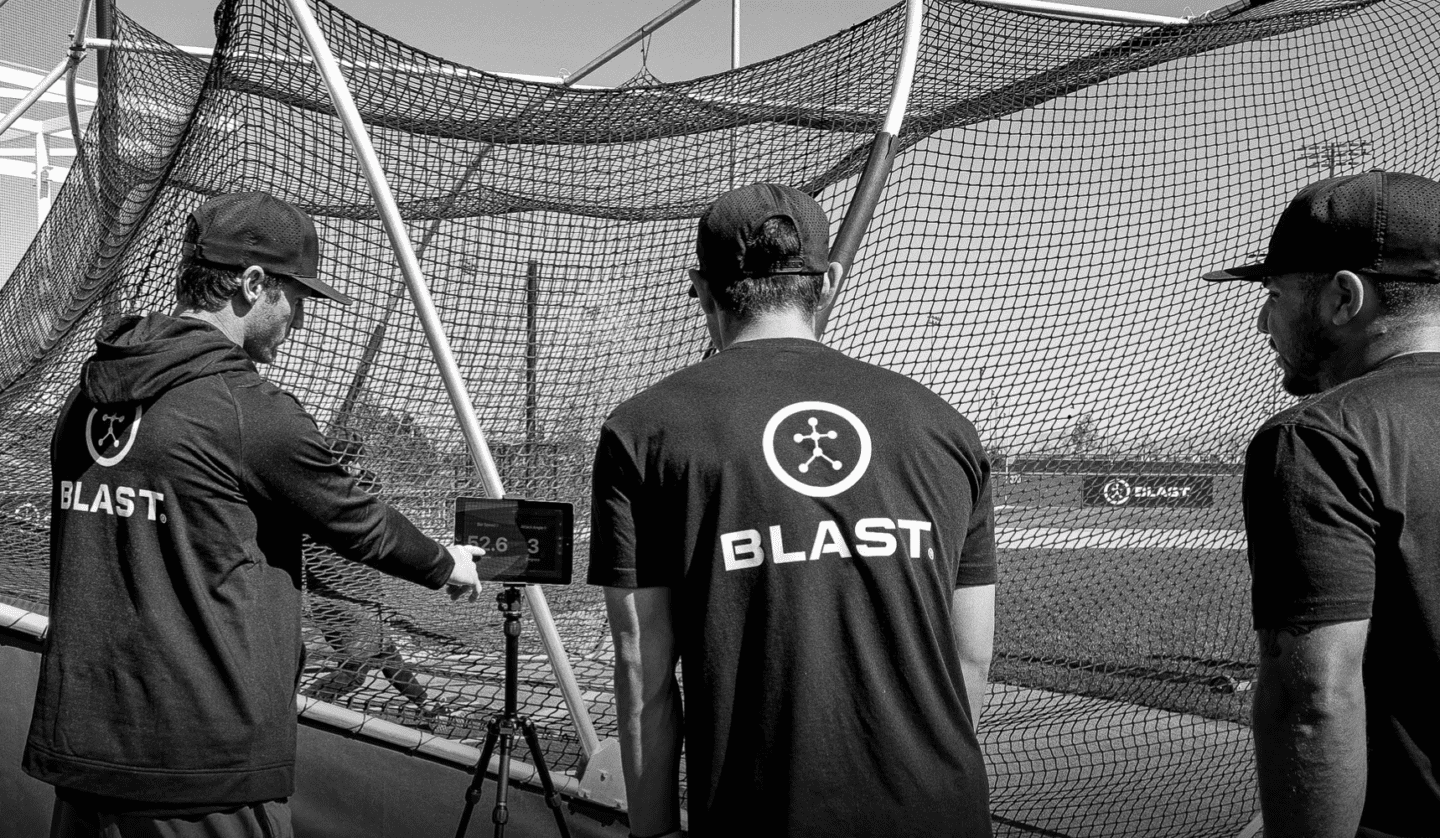
You’re running practice with 12 hitters and 90 minutes on the clock. Coach Mode lets you manage multiple players simultaneously while capturing swing data for each one. Swings upload instantly to Blast Connect and get assigned to each player for review. Organizing players by swing profile lets you tailor training plans instead of running every hitter through the same drill menu. Your leadoff hitter needs time-to-contact work. Your cleanup hitter needs rotational acceleration. They don’t train the same.
Set metric-based goals instead of feeling-based ones. Instead of “get your elbow down,” say “we’re targeting Early Connection in the 85-100° range this week.” Now both you and your athlete know exactly what to chase and how to confirm it’s happening.
C. Remote and Long-Term Development
Remote coaching is easy when you use technology to stay connected with your athletes. Blast lets coaches analyze swing metrics and video, send feedback, and build customized training plans between sessions. Practice doesn’t stop when players leave the facility.
Long-term, capturing in-game data with offline mode can help you see how metrics change across a full season. A connection drift mid-season is often invisible to the naked eye. Blast shows it clearly before it becomes a slump.
5. How Blast Motion Helps
Blast is a performance feedback engine powered by elite coaching, biomechanics, and 400M+ swings. Every rep is tracked with pro-level accuracy across path, speed, tempo, timing, and more. Instant insights make complex swing mechanics easy to understand.
For baseball athletes, Blast Baseball delivers every core metric through a Gen 3 bat-mounted sensor and mobile app. Blast Motion is used by 36 professional baseball teams, over 300 college programs, and thousands of high school and youth organizations.
For softball athletes, Blast Softball brings the same sensor-based precision with drills and goals personalized to softball mechanics. It’s the official partner of USA Softball and the USA Softball Women’s National Team.
For golfers, Blast Golf tracks club speed, tempo, face rotation, attack angle, hand speed, and putting metrics with Blast iQ benchmarks calibrated by handicap and club type.
Together with WIN Reality, Blast has powered over 500 million swings across VR, sensor, and AI-powered training, forming the largest swing dataset in sports. The platform doesn’t just tell you what happened. It tells you why, what to do next, and whether it’s working.
Supporting Resources
- Blast Baseball — Sensor + App Overview
- Blast Softball — Sensor + App Overview
- Blast Golf — Swing and Stroke Analyzer
- Blast Training Center — Drills, Tips, and Coaching Resources
- Early Connection: Everything You Need to Know
Start Measuring. Start Improving.
Feel-based training has a ceiling. Measurable training doesn’t. Every swing you take with a Blast sensor is a data point, a comparison, and a confirmation that what you’re doing is working — or a clear signal that it’s not. Stop guessing. Start knowing.