If you’re searching for the best bat sensor for softball 2026 has to offer, this guide cuts through the noise. You’re standing in the cage with your daughter after back-to-back travel ball weekends and no real answer to the question: is her swing actually getting better? Or you’re a high school fastpitch player grinding tee work three times a week, guessing at progress. That’s the exact problem a bat sensor solves.
Here’s what you need to know up front: most current ranking pages are baseball-first, outdated, or include tools that aren’t bat sensors at all. This guide ranks only currently supported options by real softball training value, tells you who each one is for, and gives you a clear recommendation — including the real costs and real limitations, not just the highlights.
1. Quick Verdict: Best Bat Sensor Softball 2026
| Rank | Sensor | Best For | Verdict |
|---|---|---|---|
| #1 | Blast Softball | Every softball use case | Best overall — buy this, with a couple of caveats below |
| #2 | Diamond Kinetics | iOS-only youth engagement | Solid second; iOS lock-in and real accuracy complaints |
| — | Rapsodo / HitTrax | Ball-flight and exit velocity | Not bat sensors — adjacent tools |
| — | Pocket Radar | Pitch/swing speed only | Not a bat sensor |
Bottom line: For most softball buyers, Blast Softball is the strongest current option — it’s the only sensor built specifically for the sport with an active, cross-platform app. But “best” doesn’t mean “no downsides.” Read Sections 2 and 5 before you buy.
2. Best Overall: Blast Softball
Your private instructor just flagged your Attack Angle as too steep and your On-Plane Efficiency below 65%. Now she pulls up your Blast session on her phone, draws on the video, and sends it to you before you’ve left the facility. That’s Blast Softball doing exactly what it was built to do.
A. Key Metrics
- Bat Speed and Hand Speed
- Attack Angle (degrees at contact)
- On-Plane Efficiency (target: 70%+)
- Rotational Acceleration (the “0-60 time” of your swing)
- Early Connection and Connection at Impact
- Time to Contact
- Power, Distance, Launch Angle, Exit Velocity
Blast iQ automatically assesses and scores every swing, delivering actionable improvement insights with a simple green, yellow, or red visual indicator that identifies your focus area, along with drills and recommendations for improvement.
Worth knowing: like every bat-mounted inertial sensor on this list (Blast included), these are accelerometer/gyroscope-based readings, not lab-grade motion capture. They’re accurate enough to guide training decisions and track trends over time, but treat any single-swing number as a training signal, not a certified measurement.
B. Who It’s For
Fastpitch players (youth through college), slowpitch players, parents tracking a daughter’s development, private instructors, travel coaches, high school programs, college programs, and certified facilities. Custom packages are available for teams and organizations of all sizes, and you can contact a Blast representative for team pricing.
C. How Blast Motion Helps Softball Players
Blast Softball is Blast’s flagship softball platform, and per Blast’s own materials, it’s the official partner of USA Softball and the USA Softball Women’s National Team.
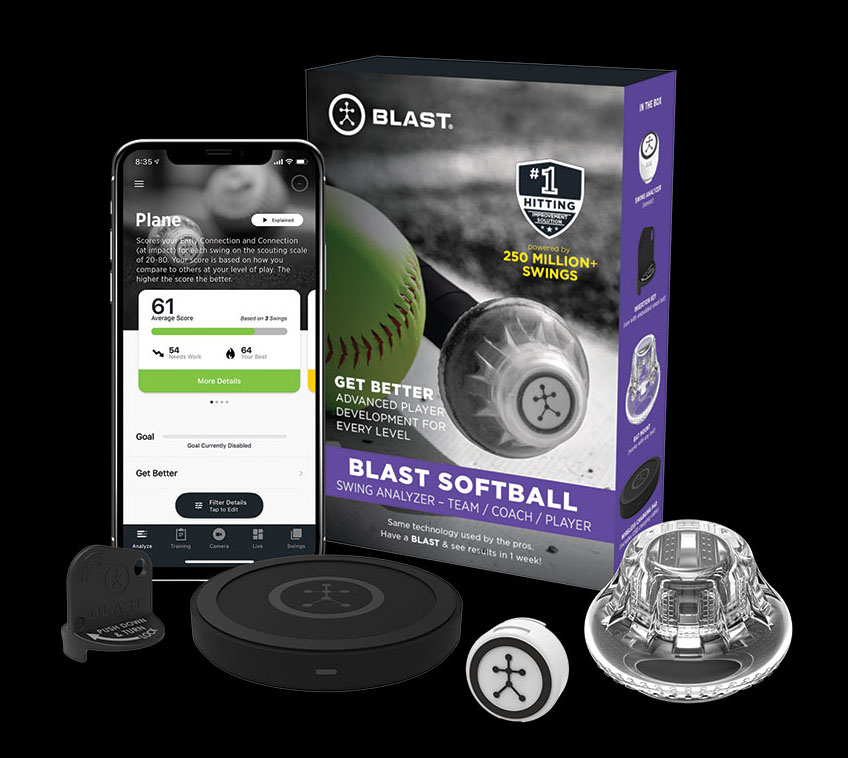
The Swing Analyzer combines sensor-based swing analysis with auto-edited video clips in an easy-to-use mobile app available on both iOS and Android. Coach Mode lets instructors manage multiple players simultaneously, with swings instantly uploaded and assigned to each player for review.
The real cost of scaling to a team. For an individual player, this workflow is genuinely smooth. For a team sharing a smaller number of sensors across a full roster, independent user reports describe real friction: switching between players on a single shared sensor is fiddlier than it sounds, and misattributed or dropped swings during live BP are a documented complaint. If you’re outfitting a team, budget for enough sensors that players aren’t constantly swapping one device — and budget for the subscription. Blast’s sensor runs $119.96–$149.95 retail, and team-scale accounts have historically run around $100/year for the team platform plus roughly $8/month per added athlete on top of that. Get the current team quote directly from Blast rather than assuming a single-player price scales linearly.
Player and Team Reports let you monitor progress over time, organize players by swing profile, and tailor training plans to each athlete’s needs.
Click here to shop Blast Softball
Three Ways to Train with a Bat Sensor
Getting the most from your sensor means using the right method for the right situation. Here are three proven approaches:
Method 1: Tee Work for Mechanics.
Isolate your swing with a stationary ball. This removes timing variables so you can focus on Attack Angle, On-Plane Efficiency, and Connection at Impact. Set up identically every session — same tee height, same bat, same stance — and take 20 swings to establish a session average. This is your baseline.
Method 2: Front Toss for Timing.
Add movement and timing to your mechanics baseline. Monitor Time to Contact as pitch speed increases. Watch for OPE drops when timing pressure is introduced — that gap between your tee numbers and front toss numbers tells you exactly where your swing breaks down under game conditions.
Method 3: Live BP for Game Reads.
Full workflow under game-speed conditions. Note how your Bat Speed and OPE shift from tee work to live pitching. If your numbers hold, the mechanical changes are sticking. If they drop, you have more tee work to do. Use video overlays to verify what you see in the data before changing anything.
4. How Blast Motion Helps: The Coaching Platform Behind the Sensor
The sensor is the entry point. The platform is where development actually happens.
Blast iQ scoring gives every swing a clear color-coded assessment with targeted drills. Coach Mode lets instructors plan, manage, and communicate with players during and after practice, with swings instantly uploaded to the platform and assigned to each athlete. Video is auto-edited and overlaid with swing information for instant analysis — pull the video before you change anything when a metric looks off.
For teams and facilities, Player and Team Reports provide progress tracking over time, custom reporting, and the ability to rank players by swing profile to tailor training plans. Blast Softball is purpose-built for softball at every level, from a 10-year-old in rec ball to a college program building a recruiting class.
5. Other Options to Know
A. Diamond Kinetics (DK)
The DK Bat Sensor attaches to almost any bat and tracks metrics like barrel speed, max acceleration, and attack angle. It has legitimate youth engagement features like games, challenges, leaderboards.
Diamond Kinetics is iOS-only and not available for Android, and its content skews heavily toward MLB comparisons rather than softball-specific mechanics and benchmarks. Beyond that: independent App Store reviews report real accuracy complaints (one reviewer’s home-run-derby test showed the sensor’s estimated distance falling far short of the actual distance) and app stability issues during live batting practice sessions, including swings failing to log correctly.
If you’re an iOS household with a young player who needs motivation to take reps, DK still earns a look for the gamification alone, but go in knowing the metrics may need a skeptical eye, and confirm current app stability before committing a whole team to it.
B. Rapsodo and HitTrax
These are ball-flight systems. They measure exit velocity, launch angle, and distance using cameras and radar. Valuable tools, but not bat sensors. They don’t mount to your bat and don’t measure what your swing is doing. Use them to add a second layer at a facility if you want ball-flight data alongside your Blast swing metrics.
C. Pocket Radar
Pocket Radar is a pitch and swing speed tool, useful for quick reads but not built for swing analysis or coaching workflows. Do not buy as a primary training tool. If you want real swing development, step up to a platform that can actually track your progress over time.
6. Metrics That Matter Most
Bat Speed — Your ceiling metric. Softball fastpitch HS / travel 16U-18U target: 51-61 mph. Travel 12U-14U target: 46-56 mph. Track session averages, not single-swing peaks. Note that these numbers are lower than the baseball benchmarks for the same age groups, so don’t compare your daughter’s numbers against a baseball chart.
Attack Angle — Degrees the barrel travels upward at contact. For fastpitch HS and travel players, the target zone is 0° to +15°, with most competitive hitters averaging around 9-10°. A negative attack angle is the real signal that you’re chopping down on the ball rather than matching the pitch’s downward angle into the zone. Flat or slightly positive is where you want to live.
On-Plane Efficiency (OPE) — The percentage of your swing on the pitch plane. Target 70%+, with an acceptable range of roughly 65-85%. Low OPE means your barrel is cutting through the zone rather than staying on it.
Connection at Impact — Measures hand-to-body relationship at the moment of contact. Target 90°, with an ideal range of 80-95°. Poor connection means your upper and lower halves aren’t syncing at the point that matters most.
Early Connection — A related but distinct metric measuring that same hand-to-body relationship earlier in the swing. Target 90°, with a wider ideal range of 80-105°.
Rotational Acceleration — The power indicator. High RA is what creates game power from a mechanically sound swing.
Maximizing bat speed at the expense of everything else makes you a worse hitter in games. The goal is improving all three pillars simultaneously: Bat Speed, Bat-to-Ball, and Swing Decisions.
7. Setup, Subscriptions, and Rules
Setup: Install the app, register, and pair the sensor. Attach it to the knob of your bat using the universal attachment. No calibration necessary. Blast Softball is compatible with both iOS and Android.
Multiple athletes: Membership connects to an account, not a physical sensor, so multiple athletes can technically use the same sensor with separate accounts. In practice, if you’re outfitting more than a couple of players on one shared sensor, expect some friction switching between profiles mid-session. Plan for enough sensors that this isn’t a bottleneck during team practice.
Subscriptions and real costs: Full feature access requires a subscription. It unlocks Blast iQ scoring, advanced metrics, video overlays, and Coach Mode. The sensor itself retails for roughly $120-150. Individual subscriptions typically include a free trial period at purchase; team/coach accounts have historically run in the range of $100/year for the platform plus a per-athlete monthly fee on top. Confirm current pricing directly with Blast before budgeting for a full roster — the data without the coaching layer is significantly less useful, so don’t plan to skip the subscription to save money.
Game-use and legality: Bat sensors are practice and training tools, but they’re increasingly allowed in competition too. Rules vary by governing body and age level, so check before you attach one for a game. USA Softball’s 2026 rule changes explicitly clarify that internal or external bat sensors are allowed during play, provided the sensor is securely attached and has a distinguishing “offline” mode that prevents data from being accessed during the game. See USA Softball’s certified equipment page and NFHS’s bat certification resource for the current lists.
Supporting Resources
- Blast Softball product page — sensor details, team packages, and the certified facilities program
- Blast Motion FAQ — app setup, supported devices, subscription details, and metric definitions
- Best Baseball Bat Sensor 2026 — the companion baseball guide for cross-sport comparison
For most softball players, parents, and coaches, Blast Softball is the strongest current bat sensor option. It’s the only one built specifically for the sport, backed by an active cross-platform app, and connected to a coaching layer deep enough to serve a 10-year-old in rec ball and a college program at the same time. It’s not flawless: team-scale costs add up, and sharing sensors across a full roster takes real planning.
Diamond Kinetics remains a legitimate second choice for iOS-only households prioritizing youth engagement, with the caveat that its accuracy and stability complaints are worth checking before you buy. Build your baseline, track your trends, go in with real numbers in front of you, and train with a purpose behind every swing.
One distinction worth keeping in mind as you build out a training plan: a bat sensor tells you what your swing did mechanically. It doesn’t train the separate skill of deciding whether to swing in the first place. That’s pitch recognition and plate discipline, which WIN Reality’s TrainVR is built for. Different problem, different tool; most serious hitters eventually want both.