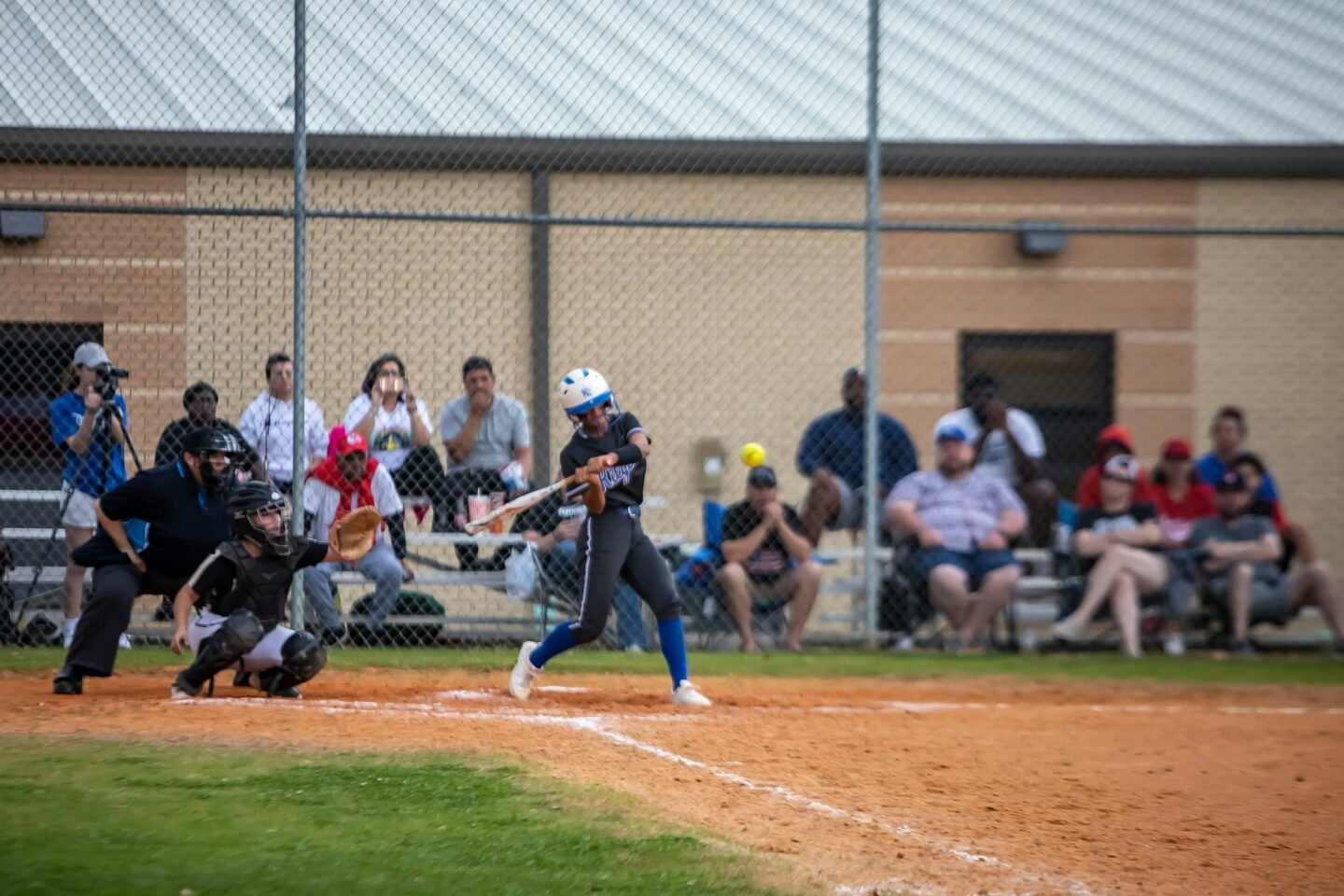
It’s 12U tryouts, and a parent leans over the fence to ask the coach one question: “What’s a good exit velocity for her age?” It’s fair, and it deserves an honest answer. Exit velocity climbs as an athlete ages and gets stronger, but there is no single trustworthy softball exit velocity by age chart, because the bat, the measuring device, and whether she’s hitting off a tee or live pitching all move the number. The reliable path is to know the bat-speed benchmark for your level and track your own exit velocity trend over time.
Exit Velocity in Softball
Your athlete crushes a line drive, and the radar flashes 68 mph. That’s exit velocity: the speed of the ball as it leaves the bat. It is not bat speed. Bat speed is how fast the barrel is moving through the zone, and it’s an input. Exit velocity is the output, the result of bat speed, barrel accuracy, and how squarely the ball meets the sweet spot.
Blast Softball tracks both. Bat Speed, Hand Speed, Power, Distance, Launch Angle, and Exit Velocity all show up in the app after a swing, so you can see the cause and the effect side by side. When two hitters post the same exit velocity but different bat speeds, the slower-barreled hitter is squaring the ball up better, and the app shows you exactly that.
Exit velocity tells you what happened to the ball, and bat speed tells you why.
Why There’s No Clean Exit Velocity by Age Chart
A coach asks for a printable chart that says “10U should hit X, 14U should hit Y.” That chart doesn’t exist in any trustworthy form, and here’s the honest reason.
Blast Motion has not published age-specific softball exit velocity benchmarks. We won’t invent them, and we won’t borrow baseball’s numbers, because softball is a different bat, ball, and swing.
Three variables break any single chart:
- Bat standards differ. A USA Softball (ASA) certified bat and a USSSA bat have different performance limits, so the same swing produces a different ball speed.
- Devices disagree. A bat-mounted Blast sensor, a stadium radar gun, and a HitTrax cage system each measure differently, so a “70” on one is not a “70” on another.
- Context changes everything. Tee work produces different readings than live pitching, where timing and pitch speed add or subtract velocity.
Chasing a fake-precise chart sets your athlete up to feel behind or falsely ahead. Honesty beats a number that doesn’t hold up.
Measure consistently and compare her to herself, then use bat speed by level as your real benchmark.
The Benchmark We Publish by Level: Bat Speed
Here’s where you get a real number. Blast Softball measures bat speed across 400M+ captured swings, and unlike exit velocity, bat speed benchmarks by level of play hold up because they describe the swing itself, not the ball off a specific bat.
| Level | Bat Speed (mph) |
|---|---|
| Recreational | 32–46 |
| Travel Ball 12U–14U | 38–52 |
| High School JV | 42–56 |
| High School Varsity | 49–63 |
| Travel Ball 16U–18U | 54–66 |
| College | 58–70 |
| Professional | 63–75 |
Bat speed is the trainable driver of exit velocity. Add mph to the barrel, keep contact square, and the ball comes off harder. That’s why your development plan should target the bat-speed range for your level, then confirm the payoff in your exit velocity trend. For the mechanics that build that speed, read Blast’s guide to softball swing mechanics.
Click here to shop Blast Motion
How Exit Velocity Grows With Age
A 13-year-old hits 58 mph off the tee in the fall and 63 mph by spring. That jump is normal, and it explains why a softball exit velocity by age snapshot is so misleading. Developing teen hitters commonly add about 3–5 mph per year, with the biggest jumps landing between 14 and 16 as strength, hip drive, and coordination arrive together.
The growth is not linear. A player can hold flat for months, then add 6 mph in one strength cycle after a growth spurt or a focused off-season block. It’s driven by physical development and swing efficiency, not by a birthday. A late-developing 14-year-old and an early-developing 14-year-old can be 10 mph apart and both be right on track.
An age chart backfires most at the edges. Line an early developer up against the average and she can look like a star before her swing has truly improved. Line a late developer up against that same average and she looks behind when she is right on schedule. A healthy trend is simple: her measured average climbs from one block to the next, even when a single month sits flat. That climbing average is the real proof the swing is improving.
So don’t compare your athlete to a chart for her age. Compare her fall number to her spring number, and make sure the line is going up.
Year-over-year progress is the real benchmark, not a fixed age target.
Measure Your Exit Velocity the Right Way
Two teammates post exit velocity on Instagram, one at 72 and one at 65, but one used cage radar and the other used a tee at home. The comparison is meaningless. Here’s how to get numbers you can trust.
- Lock your device and standard. Use the same sensor or radar and the same bat every session, so changes reflect the swing, not the setup.
- Track your average across 10+ swings. One peak reading is noise. Your average over a full round tells the truth about where you are.
- Keep tee and live separate. Compare tee to tee and live to live, never mix them in the same trend.
- Log every session in the Blast app. Your Exit Velocity trend lives next to bat speed and Blast iQ scores, so you see progress across weeks, not just today.
For broader context on age-based batted-ball data across the diamond, Bat Digest’s exit velocity resource is a useful outside reference.
Consistent measurement turns exit velocity from a brag number into a coaching tool.
Raise Your Number: Train the Inputs
A hitter with clean contact still stalls at 60 mph, and the app shows low Power and weak bat speed. Swinging harder won’t fix it. The answer is hip-shoulder separation, the stretch between your hips firing and your shoulders following that stores energy for the barrel.
Here is how that stretch pays off. When your hips fire first and your shoulders lag, the barrel gets whipped through the zone faster, and a squarer path through the ball converts that speed into a harder-hit ball. Confirm it in the app: watch your Power and Exit Velocity trends move together over a few weeks. When both climb while your On-Plane Efficiency holds at 70%+, the separation work is landing. Trust the trend across sessions before you trust any single day.
When low bat speed traces back to insufficient hip-shoulder separation, run these:
- Torque Drill to train the hips to lead and the shoulders to lag, building the stretch that adds barrel speed.
- Knob to Knee Drill to sequence the hands correctly out of that separated position.
Need more separation on its own? Add the Shoulder Slot Drill. And keep your On-Plane Efficiency at 70%+, because a fast barrel off plane leaks the exit velocity you just built.
Two cues to feel it:
- “Back pocket down the line” to load the pelvis before you fire.
- “Land firm, turn behind your front hip” to convert that load into forward energy.
Train separation and stay on plane, then watch your average exit velocity climb.
Supporting Resources
Keep building with these: study the movement in Blast’s softball swing mechanics guide, understand the metric itself in what is exit velocity, and see the full sensor and app in Blast Softball.
Stop chasing a chart that doesn’t exist. Know your bat-speed benchmark, measure your exit velocity the same way every time, and train the inputs that move it. Do that, and your number goes up for the reason that matters: a better swing.