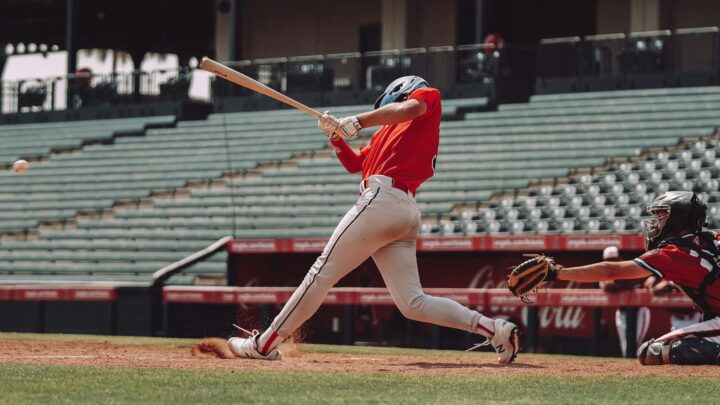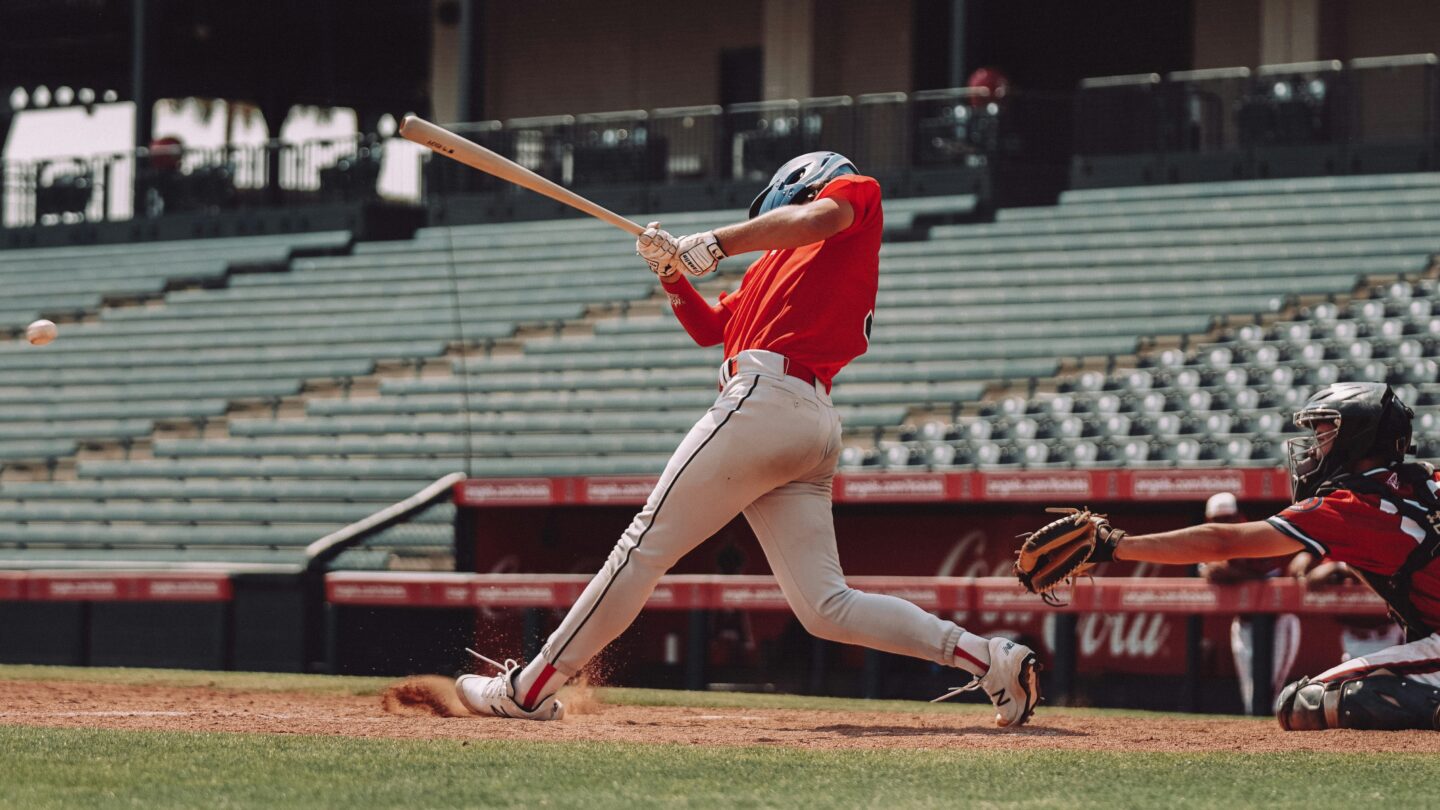
You step into the cage, take your best rip, and Blast Baseball flashes a number back at you — rotational acceleration, measured in g’s. Most hitters look at their bat speed first and move on. That’s a mistake. Rotational acceleration is the metric that separates hitters who are fast from hitters who are dangerous. Here’s exactly what it means, why Blast is the only sensor brand that tracks it this way, and how to use it in your training.
The Short Answer:
Rotational acceleration measures how explosively your bat launches out of your load and into the swing plane, reported in g’s. It’s captured early in the swing — from the Transition-Go Event until the back elbow slots — making it a precise, repeatable measure of your ability to accelerate the barrel quickly. The MLB average is 17 g’s. Higher rotational acceleration means more time to read the pitch and more consistent power at contact.
1. Rotational Acceleration, Defined
Rotational Acceleration measures how quickly your bat accelerates into the swing plane. It is a Blast-exclusive metric captured by the bat sensor and reported in g’s — a unit of gravitational force equal to approximately 32 feet per second per second.
It’s not measuring how fast your barrel is at contact — it’s measuring how explosively the bat launches out of your load. Blast measures it from the Transition-Go Event until the back elbow is slotted. That early-swing measurement window allows precise comparisons from swing to swing and from player to player, minimizing the impact of pitch location and type.
No other sensor brand publishes this metric with this definition and measurement window. The MLB average rotational acceleration is 17 g’s.
2. Rotational Acceleration vs. Bat Speed
Bat speed tells you how fast your barrel is moving at impact. Rotational acceleration in a baseball swing tells you how quickly you got there. Those are two very different things — and confusing them will point your training in the wrong direction.
Think of it like a car: all cars can reach 60 mph, but some get there a lot faster. That’s the critical distinction.
If two hitters both swing at 75 mph, the one who reaches that speed faster has higher rotational acceleration — and a real advantage when it matters.
Both metrics matter. Bat speed without quick acceleration means you got there early and gave the pitcher time to fool you. High acceleration without speed means you arrive fast but don’t hit the ball hard enough. The best hitters score well on both.
3. Why Athletes Should Care
The real-world value of rotational acceleration comes down to one thing: decision time.
The quicker your rotational acceleration, the more power you’ll generate and the more time you have to make a decision at the plate. A hitter with lower RA has to commit earlier, which makes them far less adaptable — especially against advanced pitchers throwing multiple pitches out of the same tunnel.
At the higher levels — High-A, Double-A, Triple-A, MLB — pitchers have arsenals designed to look identical until the last possible moment. When pitches all come out of the same tunnel, you have to make a later decision to swing, and to do that, you have to accelerate the bat as quickly as possible.
4. What Your Number Can Tell You
Your rotational acceleration number isn’t a verdict — it’s a signal. Here’s how to read it in three contexts:
A. Benchmarks
- MLB average: 17 g’s
- Below 10 g’s = low; 10–14.99 g’s = medium; 15+ g’s = high
B. What the Number Reveals
Low RA often means:
– Rotation is initiating too late or with too much hand-push
– Lower-body instability is bleeding force before it reaches the barrel
– The bat may be too heavy for your current strength base
High RA often means:
– Your kinetic chain is sequencing correctly — Pelvis ? Torso ? Arms ? Hands ? Bat
– Hip-shoulder separation is creating a slingshot effect through the zone
– You’re building to peak bat speed early, leaving more time to read the pitch
C. Tracking Change Over Time
- A mid-season dip can flag fatigue or a physical issue before it becomes an injury
- A jump from tee work to live BP means competition is unlocking your real swing capacity and your mechanics translate well across settings
- Consistency across settings — cage, front toss, live BP — confirms repeatable, trustworthy mechanics
5. High Is Not Always Better
A high rotational acceleration score doesn’t automatically mean a good swing. There are two paths to a high number — and only one of them helps you.
Good high: You’re using the kinetic chain correctly. Pelvis fires first, torso follows, lead arm connects, and the hands deliver last. Proper sequencing transfers more energy up the chain and into the bat — earlier in the swing — instead of pushing it with the hands.
Bad high: You’re casting — hands firing before the body — and the sensor is reading that pull-and-push pattern as fast acceleration. Rotational Acceleration is a good indicator of whether you’re building bat speed through proper sequencing or pulling the bat with your hands. If your hands fire before your torso, you may score high in g’s but your On-Plane Efficiency and Early Connection will expose the problem.
Signs your high number may be a red flag:
– Early Extension — spinning open before contact
– Early Connection angle outside the 80–105° target range
– On-Plane Efficiency (OPE) below 70% despite a high g score
Never chase the metric alone. Check video alongside your metrics and make sure sequencing — not hand speed — is driving the number.
Click here to shop Blast Motion and start measuring your rotational acceleration today.
Tools and Methods
Three training methods put rotational acceleration data to work:
Method 1: Baseline Tee Work
Start every session with 10–15 max-intent tee swings and check rotational acceleration after each set of five. Your tee number is your floor — if you can’t hit a strong RA in a controlled environment, you won’t have it in a game. Stop if form breaks down.
Method 2: Progression to Live Velocity
Move from front toss to live BP and track how your RA holds. A drop of more than 2 g’s from tee to front toss means your load and stride are eating time. A jump of 3–5 g’s in live BP is a good sign — it means competition sharpens your intent and your mechanics hold under pressure.
Method 3: Fatigue Monitoring
Run three sets of 10 swings at full intent with rest between sets and track the median RA per set. A declining number across sets is your body telling you force production is fading — the most honest fatigue signal a hitter has. When numbers fall, rest longer or stop.
Cues that move the number:
– “Back pocket down the line” — drives the pelvis first, delays the hands
– “Land firm, turn behind your front hip” — locks the front side so the torso fires through
– “Short to it, long through it” — eliminates casting and keeps the barrel on plane
How Blast Motion Helps
Blast Baseball is the only sensor that measures rotational acceleration as a defined, published metric — captured precisely during the early swing window and displayed in real time inside the Blast app. Every Blast Baseball sensor gives you rotational acceleration alongside bat speed, time to contact, On-Plane Efficiency, Early Connection, and more.
Use Blast iQ™ to track your rotational acceleration trends over time, compare your tee numbers to live BP numbers, and get automatic video editing with metric overlays so you can connect what you feel to what the data shows. When your cues produce real g changes, you’ve found a repeatable key.
Pair rotational acceleration with your full Blast metric profile — bat speed, OPE, Early Connection, and exit velocity — every session. One number never tells the whole story.
Supporting Resources
- Blast Baseball product page — sensor, Blast iQ™ scoring, and full metric suite including Rotational Acceleration
- Blast Connect Rotational Acceleration metric guide — Blast’s official metric definitions and context
- How to Evaluate Power at the Plate with Blast Motion Metrics — deeper dive into pairing RA with bat speed in a full power profile
Build a Smarter Swing
Rotational acceleration is your swing’s launch rate — not your ceiling, not a standalone grade. Measure it. Pair it with bat speed, time to contact, OPE, and Early Connection. Use it to monitor your sequencing, your fatigue, and your readiness to handle better pitching. One number never wins games — the full picture does.
Click here to shop Blast Motion and start measuring rotational acceleration in every swing.