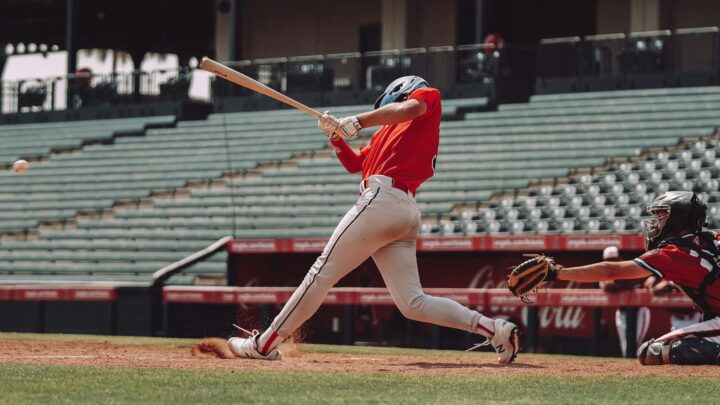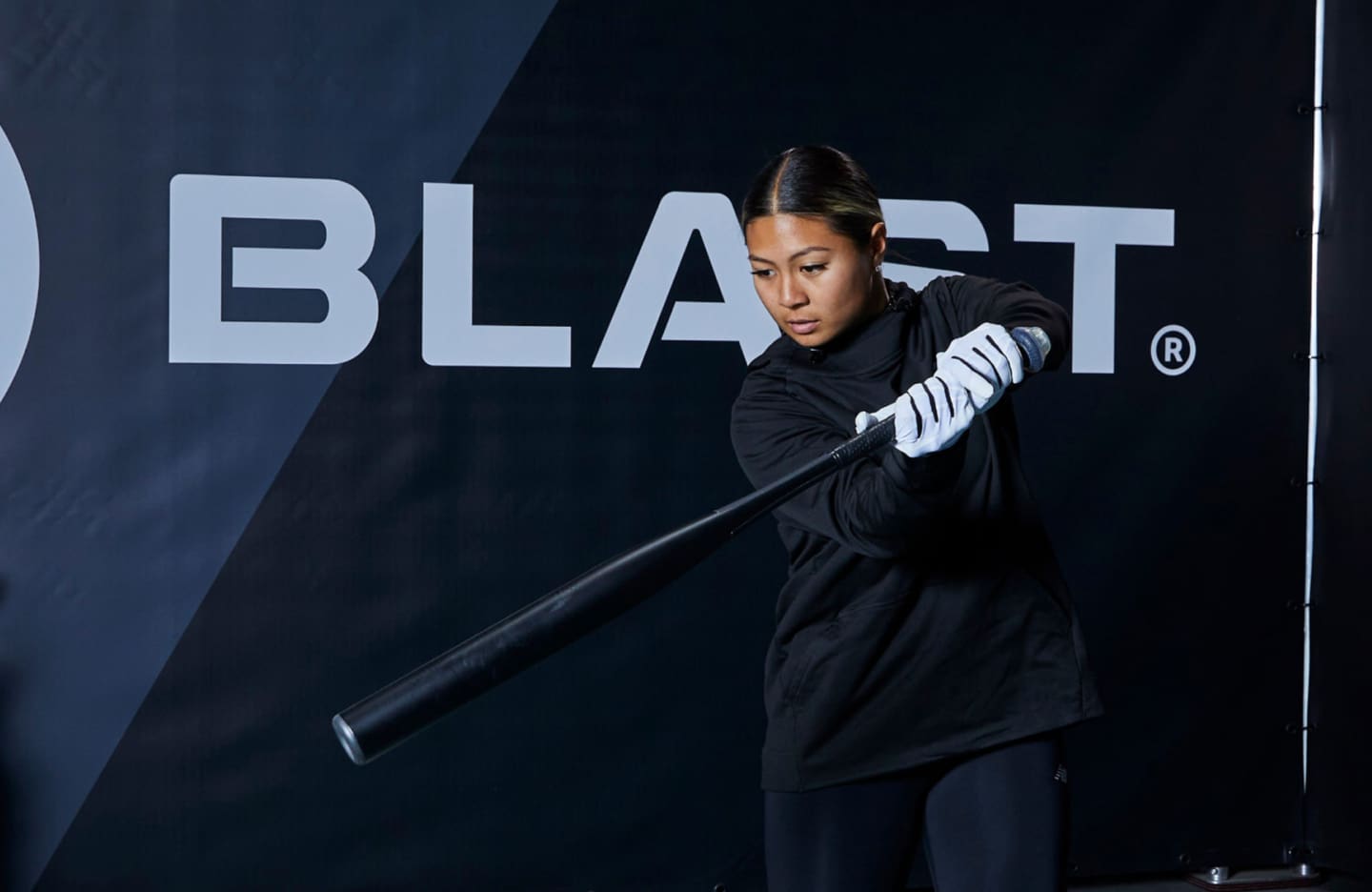
You step into the box against a pitcher throwing 65 mph from 43 feet. You have roughly 0.43 seconds from release to contact. Every hundredth of a second you waste in your swing is a hundredth of a second you lose on pitch recognition. That is exactly where Time to Contact becomes one of the most valuable numbers in your development.
The Short Answer:
Time to Contact is the elapsed time between the start of your downswing and the moment of impact. In softball hitting, a lower number means you have more time to read the pitch before committing. Blast measures this in seconds, compares it to level-specific benchmarks, and pairs it with other metrics so you can actually improve it.
1. Time to Contact, Defined
Time to Contact is the elapsed time between the start of the downswing and impact. Blast uses an advanced algorithm to detect when functional forward bat speed is initiated, so the clock does not start on bat waggle or early pre-swing movement. This distinction matters. Blast is not measuring how long your entire pre-pitch routine takes. It measures the mechanical window that begins the moment your bat commits forward and ends at impact.
The number shows up in your app in seconds, typically displayed to three decimal places (e.g., 0.155s). Blast’s feedback is powered by elite coaching, biomechanics, and 400M+ swings, which means the benchmark ranges are built from real softball swing data across every level of play.
Think of Time to Contact as your swing’s internal stopwatch. It does not care how you felt at the plate or how hard the pitch looked. It measures exactly how long your bat took to travel from “go” to ball.
2. What Time to Contact Is NOT
You have heard the cues: “be quick,” “short to it,” “get your hands in faster.” All of those ideas are related to Time to Contact, but none of them are the same thing.
Here is what Time to Contact does NOT measure:
- Reaction time. Reaction time is the cognitive delay between seeing the pitch and deciding to swing. Time to Contact begins after that decision has already been made.
- Bat speed. Bat speed tells you how fast the barrel is moving at contact. Time to Contact tells you how long it took to get there.
- Being “on time.” Timing a pitcher means your decision to swing aligns with ball movement and location. Time to Contact is a mechanics measurement.
- Swing length. As Blast Coach Rick Strickland explains, a shorter path does not automatically produce a lower Time to Contact. It is not just about how fast you get there, but the route you take.
Know what your number actually tells you before you start training to change it.
3. Why a Faster Number Can Help in Softball Hitting
Picture two hitters with the same bat speed. One gets her barrel to the contact zone in 0.145 seconds. The other takes 0.175 seconds. That 30-millisecond gap is the difference between seeing a late-breaking rise ball and being frozen by it.
A lower Time to Contact gives you:
- More decision time. A mechanically quicker swing lets you wait longer before committing. That means more information about pitch location and movement before you have to go.
- Better adjustability. A faster path to contact gives you room to adjust to off-speed pitches and tricky release angles.
- Less rushed contact. When you are late, contact becomes defensive. A quicker Time to Contact allows the barrel to arrive in control, not in desperation.
- Clearer feedback on mechanics. As RPP Baseball’s metric review notes, if your Time to Contact is higher than it should be, it may simply mean you cannot get to the ball fast enough after the decision to swing. That is diagnostic information your eyes cannot give you.
The goal is not the smallest possible number. The goal is a number that stops costing you plate decisions.
4. What Good Time to Contact Looks Like
Your Time to Contact target depends on your level, your bat, and your swing style. As the Blast Training Center notes, typical Time to Contact also varies by age, strength, bat length and weight, experience level, and whether you are taking practice swings or game swings.
A. Level-Based Benchmarks
- Professional: 0.14 to 0.18 seconds
- College: 0.15 to 0.20 seconds
- Travel Ball 16U to 18U: 0.15 to 0.21 seconds
- High School Varsity: 0.15 to 0.21 seconds
- High School JV: 0.16 to 0.22 seconds
- Travel Ball 12U to 14U: 0.16 to 0.22 seconds
- Recreational: 0.18 to 0.25 seconds
B. Equipment Factors
Bat weight and length matter. A heavier or longer bat will produce a higher Time to Contact even with identical mechanics. If you recently moved up a bat size, expect a temporary increase. Do not assume that number reflects a mechanics breakdown.
C. Context Matters
Tee numbers run lower than live numbers because a tee removes timing pressure and your path is generally cleaner. Do not assume your tee Time to Contact represents your live swing. Also note that as Cornerstone Coaching Academy found, players with a very low Time to Contact (under 0.14s) often sacrifice bat speed for quickness and fail to generate productive power or attack angle. Chase efficiency, not just speed.
5. Tools and Methods for Improving Time to Contact
Three training methods consistently produce measurable improvement in Time to Contact when paired with Blast data.
Method 1: The Shoulder Slot Drill. Use this when your Time to Contact is high and your On-Plane Efficiency score is also low. The goal is training a more direct bat path. The cue is “short to it, long through it.” The barrel should enter the zone early and stay there.
Method 2: The Stop at Contact Drill. Use this when your Time to Contact is low but contact quality is weak. Freeze at the moment of contact and check where your barrel actually is. Pair this with Attack Angle feedback in the app and confirm you are arriving at +4° to +12°.
Method 3: Early Load Timing Reps. Use this when your numbers look clean off the tee but spike in live at-bats. The swing is not broken; the trigger is late. The cue is “when the pitcher starts to move, you start to move.” Get your front foot down earlier and let bat speed data in your Blast app confirm the trigger is the variable, not the swing path.
6. How Blast Motion Helps Softball Hitters Track This Metric
The Blast Softball sensor and app are the only tools that natively track Time to Contact for softball athletes with level-specific benchmarks built from real swing data.
Blast iQ automatically assesses and scores every swing to provide actionable improvement insights. A green, yellow, or red visual indicator identifies your focus area, with drills and recommendations attached. The metrics that matter alongside Time to Contact are also tracked in the same session:
- Bat Speed confirms whether quickness is producing power.
- On-Plane Efficiency (OPE) shows whether the path is efficient. As the Blast Training Center explains, as body rotation ratio and OPE become more optimized, Time to Contact drops as the hitter develops a more efficient and powerful coordinated movement pattern.
- Attack Angle (target: +4° to +12°) confirms the barrel arrived in a productive position.
- Connection at Impact (target: 90°) tells you whether your body and bat are sequencing together.
Click here to shop Blast Motion
7. Do Not Chase One Metric
Here is the trap: you see your Time to Contact is 0.185s and your level’s range starts at 0.150s. You spend the next month drilling for pure speed. Your Time to Contact drops to 0.148s. Your exit velocity drops 4 mph and your attack angle turns negative. You got faster and worse.
As Cornerstone Coaching Academy notes, Time to Contact only tells one piece of what is happening in a swing and must be taken into consideration with the rest of the swing.
Use Time to Contact as one lens. Your swing is the whole picture.
Supporting Resources: Related Blast Softball Tools
- Blast Softball Sensor and App — the only tool that natively tracks Time to Contact for softball athletes
- Blast Motion Training Center — level-specific benchmarks and drill recommendations for every metric
Turn Timing Into Feedback
Time to Contact in softball hitting is a measurable, improvable number. When you know what yours is, what it should be, and which mechanics are driving it, every session in the cage produces real information. Stop guessing why you are late. Start measuring it.